

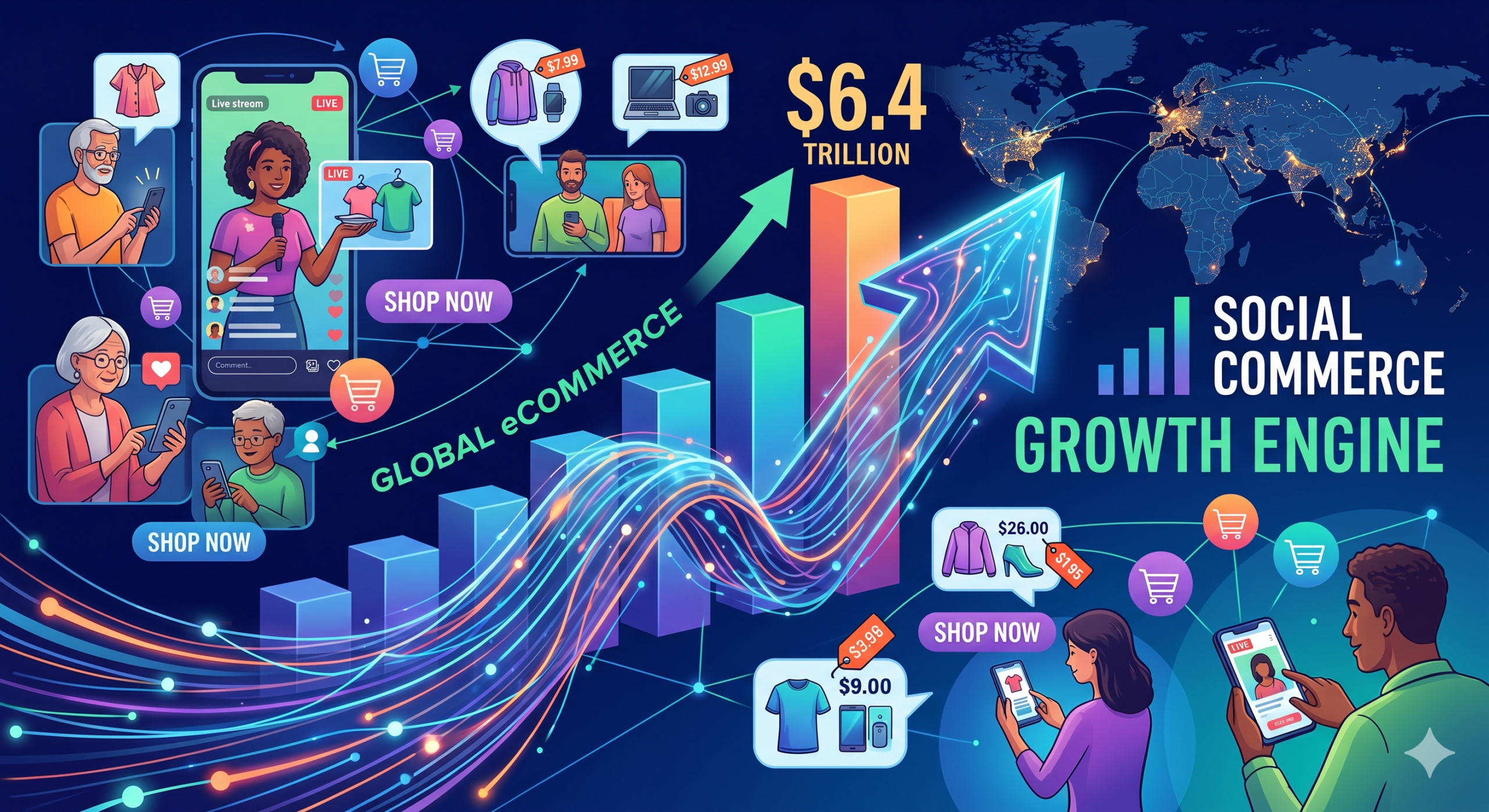
Global eCommerce has reached an impressive milestone: $6.4 trillion in total value. While this number alone highlights the scale of digital retail, the more important story is where the growth is coming from.
One of the fastest-growing segments—social commerce—is expanding at an extraordinary pace, with some markets quadrupling in size. This shift is not just incremental growth; it represents a fundamental change in how people shop.
A Market at Massive Scale
eCommerce is no longer an emerging channel—it is now a core part of global retail. With trillions in value, online shopping has become embedded in everyday life across regions and demographics.
Key drivers of this growth include:
- Increased digital adoption worldwide
- Expansion of mobile commerce
- Improved logistics and payment systems
But these factors alone don’t explain the speed of current growth.
The Rise of Social Commerce
The real acceleration is coming from social commerce, where users discover and buy products directly through platforms like TikTok, Instagram, and others.
Unlike traditional eCommerce:
- Shopping starts with content, not search
- Products are discovered passively
- Purchases happen instantly within the platform
This model reduces friction and increases engagement, making it one of the most powerful growth drivers in retail today.
Why Social Commerce Is Scaling So Fast
Several factors explain why social commerce is growing so quickly:
- High engagement: Users spend hours on social platforms daily
- Seamless integration: Buying is built into the content experience
- Creator influence: Recommendations feel more authentic
- Impulse-driven behavior: Short decision cycles boost conversions
Together, these elements create a system where attention directly converts into sales.
A Shift in Consumer Behavior
Consumer behavior is evolving from intentional shopping to discovery-based consumption.
Instead of asking:
👉 “What do I need to buy?”
Consumers increasingly experience:
👉 “I saw something interesting—and bought it.”
This shift changes how demand is created and captured.
Implications for Brands and Retailers
For businesses, this transformation has major implications:
- Marketing and sales are becoming the same function
- Content is now a key driver of revenue
- Speed and adaptability are critical to success
Brands must learn to operate in an environment where visibility depends on engagement, not just search rankings.
The Competitive Landscape Is Changing
Social commerce is also lowering barriers to entry. Smaller brands can:
- Reach large audiences quickly
- Compete with established players
- Scale through viral content
This creates a more dynamic—and more competitive—market.
The Bigger Picture
The growth to $6.4 trillion shows that eCommerce is not slowing down—but it is evolving.
The next phase of growth will not come from simply improving websites or logistics. It will come from:
- Integrating commerce into everyday digital experiences
- Leveraging content and communities
- Using data and AI to personalize interactions
Final Thought
Global eCommerce may be measured in trillions, but its future will be defined by how people shop, not just how much they spend.
Social commerce is turning shopping into something more immediate, more interactive, and more embedded in daily life.
In the end, the key question for brands is no longer:
“How do we attract customers to our store?”
but:
“How do we sell where attention already exists?”

From the publisher
Everything we know about running Amazon, in one course.
The commercial strategy, taught by operators who run our own brands.
 Erene Araojo