

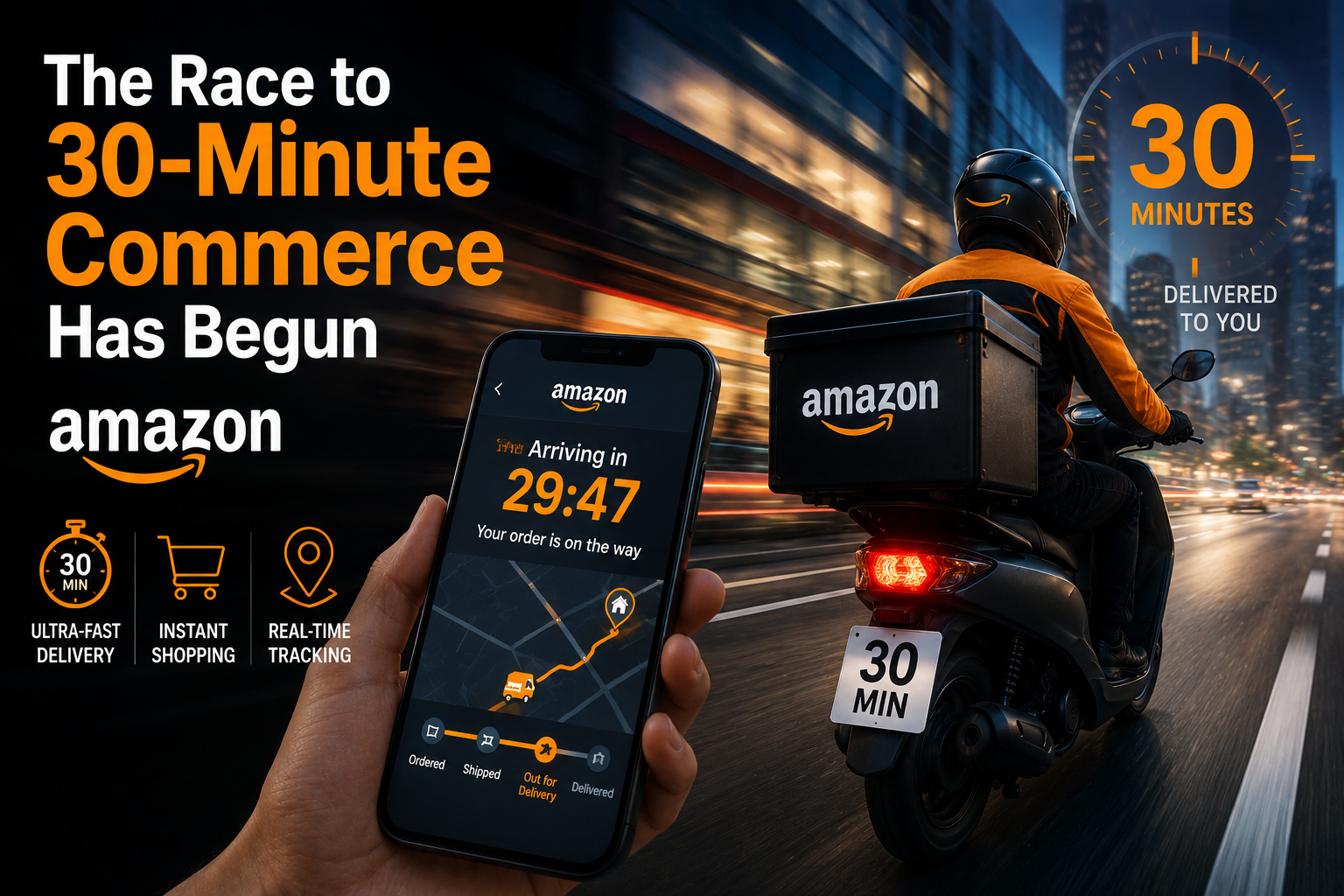
For years, retailers competed on price.
Then they competed on selection.
Then they competed on delivery speed.
Now a new battle is emerging:
👉 the race to 30-minute commerce.
Amazon is pushing delivery times closer and closer to instant gratification, and the implications extend far beyond logistics.
Speed Has Become a Product
Consumers increasingly value time as much as money.
What once felt impressive:
- two-day delivery
- next-day delivery
now feels ordinary.
The new benchmark is:
👉 near-instant fulfillment.
Speed is no longer a service feature.
It is becoming part of the product itself.
The Psychology of Immediate Gratification
Consumer expectations evolve quickly.
Once customers experience faster delivery, they begin expecting it everywhere.
This creates a powerful feedback loop:
- faster delivery
- higher expectations
- more investment in logistics
The cycle continues.
Why Amazon Is Investing So Aggressively
Amazon understands that convenience drives loyalty.
The easier it becomes to receive products, the less likely consumers are to:
- delay purchases
- compare alternatives
- visit physical stores
Speed reduces friction.
And friction is the enemy of conversion.
The Logistics Arms Race
Delivering within 30 minutes requires:
- inventory positioning
- predictive forecasting
- local fulfillment
- advanced routing systems
This is not simply a transportation challenge.
It is a data challenge.
The winners will be the companies that can predict demand most effectively.
What This Means for Retailers
Many retailers cannot match Amazon’s scale.
That creates pressure to:
- improve fulfillment
- strengthen local networks
- invest in technology
The entire industry is being forced to adapt.
The Bigger Shift
Commerce is moving toward immediacy.
Consumers increasingly expect:
- instant information
- instant entertainment
- instant communication
Retail is following the same path.
The future of shopping may be measured in minutes rather than days.
Final Thought
Amazon’s push toward 30-minute delivery is about more than speed.
It is about reshaping consumer expectations once again.
And once expectations change, every competitor must play by the new rules.

From the publisher
Everything we know about running Amazon, in one course.
The commercial strategy, taught by operators who run our own brands.
 Erene Araojo