

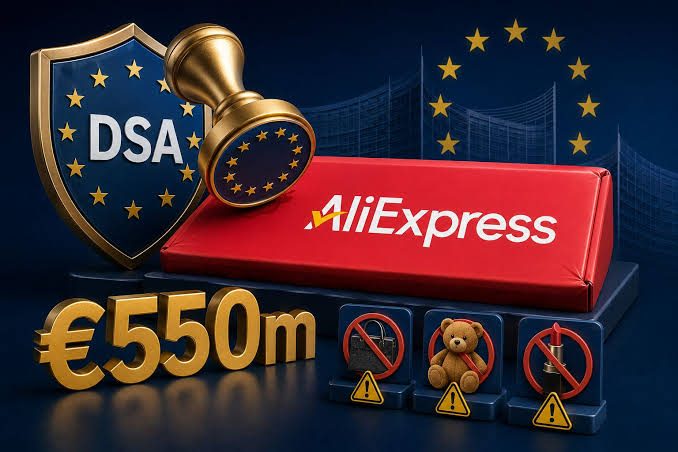
Brussels just put the largest Digital Services Act penalty ever on a low-cost Asian marketplace. The number is big, but the reason behind it is the part European sellers need to read: product safety and counterfeit control are now a regulated cost of doing business, and that reshapes who can compete on price.
On July 20, 2026, the European Commission fined AliExpress 550 million euros for breaching the Digital Services Act (DSA), the bloc’s rulebook for large online platforms. It is the highest DSA penalty the Commission has issued to date. We are covering this not as a China-versus-Brussels headline but through the only lens that matters to an operator: what a record fine for illegal, unsafe and counterfeit products does to the competitive field you sell into every day.
The thesis is simple. For years the structural advantage of the ultra-low-cost cross-border platforms has been that they could move an effectively unlimited catalogue at prices no compliant European seller could match, in part because the compliance burden sat lightly on them. This fine is Brussels putting a price on that gap. When the regulator makes safety and authenticity enforcement mandatory and expensive, the platforms built on volume-first, moderation-later economics lose part of the edge that made them cheap.
Watch: the breakdown on The E-Commerce Weekly, Ep. 3
We walk through the key takeaways in this week’s episode. Full written analysis continues below.

From the publisher
Everything we know about running Amazon, in one course.
The commercial strategy, taught by operators who run our own brands.
What the Commission actually decided
The penalty is 550 million euros. That euro figure is the one to anchor on, because the fine is denominated in euros by the Commission. The dollar conversions you will see in the coverage differ by outlet and by exchange rate: Fortune reported it as roughly 629 million dollars, while The Register put it at about 630 million dollars (and 467 million pounds). If you saw a figure around 625 million dollars elsewhere, it is the same 550 million euro fine, not a second penalty. There is one number here, and it is 550 million euros.
The Commission did not fine AliExpress for a data slip or a paperwork gap. It fined the platform for failing to control what its marketplace actually sells. According to The Register’s account of the decision, the Commission found that AliExpress’s system to detect illegal products did not work properly, that it did not properly enforce its own penalty policy against traders who repeatedly listed illegal goods, that its product compliance checks could be circumvented simply by mis-categorising a listing, and that it failed to adequately prevent the spread of counterfeit products. The Commission also concluded that AliExpress had not evaluated whether it devoted enough staff to reviewing illegal products, and had not properly assessed how its recommendation and advertising systems amplified those products to shoppers.
The products at the centre of this are not abstractions. The Commission’s Executive Vice-President for Tech Sovereignty, Security and Democracy, Henna Virkkunen, framed the case around physical harm. As quoted by Fortune, she said: “The spread of counterfeit clothing, unsafe toys, dangerous cosmetics and other illegal and harmful products is not an unavoidable cost of shopping online, it is a failure by AliExpress to comply with its obligations under the Digital Services Act.” That is the regulator drawing a line under the exact categories where a compliant brand competes against a cheaper counterfeit or an unsafe copy.
Tool comparison · FastMoss vs Kalodata
Regulatory pressure moves categories fast: a crackdown on one platform pushes demand and sellers toward others. If you sell on TikTok Shop, watching which categories are heating up (and which are drawing scrutiny) is now part of compliance, not just growth. We are building a side-by-side of two research tools sellers use to read those shifts, FastMoss and Kalodata, so you can see which one surfaces a category swing earlier.
Comparison coming soon
FTC disclosure: E-CommSphere may earn a commission if you subscribe to a tool through links we publish. It costs you nothing extra and never changes which tool we rate higher.
Why “record” is the operative word
The size of the fine is the signal. To see why 550 million euros counts as a record and not just a large number, put it next to the other DSA actions. Fortune reported that the Commission separately fined Temu 200 million euros for similar breaches, and that X (formerly Twitter) drew a 120 million dollar penalty in an earlier case. Against that backdrop, the AliExpress fine is more than double the previous marketplace benchmark. The trajectory of DSA enforcement is not flat; it is steepening, and marketplaces selling physical goods are now the priority target.
The fine could have been far larger, and that ceiling is the part operators should keep in view. The DSA allows penalties of up to six percent of a company’s global annual turnover. The Register noted that Alibaba Group reported roughly 148 billion dollars in annual revenue for the year ended March 31, which puts the theoretical maximum somewhere around nine billion dollars. The Commission chose 550 million euros, a fraction of that ceiling. The message in that gap is that the regulator is holding a much bigger stick in reserve for a platform that does not fix the problem.
And the Commission is not treating the fine as the end of the matter. AliExpress has until October 20, 2026 to submit an action plan setting out how it will bring itself into compliance, and it faces further penalties if it fails to deliver. This is a decision date, not a closed case. For sellers, that means the enforcement pressure on AliExpress, and by extension on how it polices its catalogue, continues through the rest of 2026.
What it changes for European sellers and brands
Read as a competitive event, this fine narrows the moat that made ultra-cheap cross-border listings hard to beat. A platform that has to demonstrably detect illegal goods, enforce penalties against repeat-offender traders, close the mis-categorisation loophole and staff moderation properly is a platform carrying real cost and real friction on exactly the volume that made it cheap. Those obligations do not vanish after one fine. They become the baseline the Commission will measure the October action plan against.
For a compliant brand, product safety and authenticity stop being a quiet cost centre and start being a competitive asset. If you already hold CE marking, safety documentation, authentic supply and clean category classification, you are now on the right side of the exact criteria the Commission just used to fine a competitor 550 million euros. The counterfeit copy of your product and the unsafe knock-off in your category are precisely what Brussels named. Enforcement that removes those listings, or makes the platform hosting them expensive to run, works in your favour.
The risk to watch runs the other way. Regulatory pressure rarely stays on one platform. The Register’s coverage placed the AliExpress fine alongside the EU’s broader move on cheap cross-border imports, including new customs handling fees, and named Temu and Shein as facing similar scrutiny. This connects to a thread we have followed in recent weeks around low-value import rules and de minimis. The pattern is consistent: the regulatory and cost environment for the low-price Asian channel is tightening on several fronts at once, and a seller who sources from or sells through those channels inherits that uncertainty.
Tool comparison · FastMoss vs Kalodata
When a platform gets fined for counterfeits, brand protection and category monitoring stop being optional. Knowing who is selling in your niche, and how fast a competing listing is scaling, is the first line of defence. We are comparing FastMoss and Kalodata on how clearly each maps the sellers and creators moving product in a given category, so you can spot a copycat before it takes your ranking.
Comparison coming soon
FTC disclosure: E-CommSphere may earn a commission if you subscribe to a tool through links we publish. It costs you nothing extra and never changes which tool we rate higher.
How to read the next four months
The useful posture here is neither celebration nor panic. It is attention. Three things follow directly from the facts on the table.
First, treat the October 20 action plan as the real event. The fine is the headline, but what AliExpress proposes to fix, and how aggressively the Commission holds it to that plan, is what will actually change the listings competing against yours. A platform forced to purge counterfeit and unsafe goods at scale changes the search results in your category. That is worth monitoring through the autumn.
Second, audit your own compliance as if you were the one under review. The Commission’s four findings against AliExpress read like a checklist: can illegal listings be detected, are repeat offenders penalised, can category rules be gamed by mis-labelling, and are counterfeits kept out. Turn that lens inward. Clean category classification, complete safety documentation and authentic sourcing are no longer just good practice; they are the criteria a regulator is now enforcing across the platforms you sell on.
Third, treat brand protection as demand defence. The categories the Commission named, clothing, toys, cosmetics, are the categories where a counterfeit or an unsafe copy directly steals a compliant seller’s sale. A fine that pushes platforms to remove those listings only helps the brands that are actively flagging them. The sellers who benefit most from this ruling will be the ones already watching their category for the copies Brussels just made more expensive to host.
The wider signal is the one to sit with. For most of the cross-border era, the low-cost Asian marketplace competed on a cost base that did not fully price in safety and authenticity. A 550 million euro fine, with a nine-billion-dollar ceiling behind it and an October deadline attached, is the European regulator putting that cost back on the platform. For the operators who have been carrying compliance as overhead all along, the field just tilted, slightly but unmistakably, in their direction.
Sources
- Fortune, “‘It is a failure by AliExpress’: European Commission fines the Chinese marketplace $629 million for not blocking counterfeit goods,” July 20, 2026: https://fortune.com/2026/07/20/european-commission-aliexpress-629-million-fine-temu/
- The Register, “Europe slaps AliExpress with 550 million fine for selling dodgy goods,” July 21, 2026: https://www.theregister.com/legal/2026/07/21/europe-slaps-aliexpress-with-550-million-fine-for-selling-dodgy-goods/5275428
- Honolulu Star-Advertiser (AP), “AliExpress hit with record $629M EU fine over illegal products,” July 20, 2026: https://www.staradvertiser.com/2026/07/20/breaking-news/aliexpress-hit-with-record-629m-eu-fine-over-illegal-products/
- European Commission press release, ref. IP/26/1654 (primary; title/ref confirmed via search): https://ec.europa.eu/commission/presscorner/detail/en/ip_26_1654
Verification note: the original BBC link (bbc.com/news/articles/cp8714286dpo) could not be opened in production, so it is not cited; the piece is anchored on the corroborating coverage above. The 550 million euro figure is the fine as denominated by the Commission; dollar figures differ by outlet as a currency conversion, not a second penalty.
 Erene Araojo