

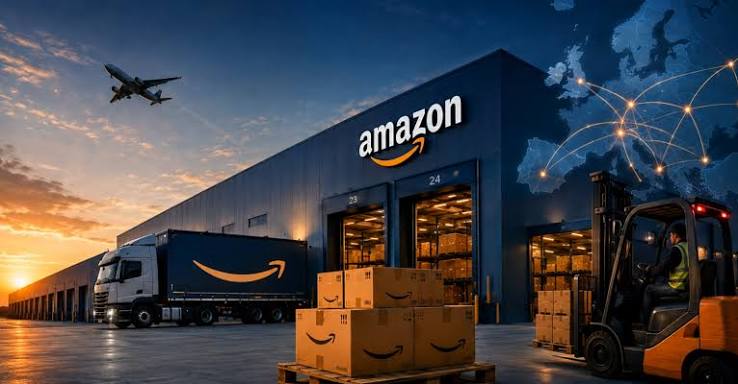
Amazon Warehousing and Distribution went live in Germany, France, Italy, Spain and the United Kingdom on 20 August 2026, with inbound shipments accepted from 17 August. It is flat rate long term bulk storage sitting upstream of FBA, with automatic replenishment into fulfilment centres as demand pulls stock through. Europe’s five largest ecommerce markets, all of them markets where Amazon leads, get a service that has run in the United States for roughly four years.
The launch is not the story. What did not come with it is. In the United States, AWD stock can be pushed outward to destinations that have nothing to do with Amazon. In Europe it cannot. Europe is getting the narrower product, and nobody is saying so.
What actually opened
The mechanism is simple enough to describe in one sentence. You send inventory in bulk to an AWD site, Amazon holds it at a flat rate with no peak surcharge, and auto replenishment tops up your FBA quantities without you raising a shipment. The stated benefits follow from that: bulk stock sits outside your FBA capacity limits, and restocking stops being a manual job you get wrong in November.
Two operational details are worth more than the announcement language. The first is the physical footprint. The European build is reported as two sites, one in South Yorkshire in England and one in North Rhine-Westphalia in Germany, with the UK and EU running as separate networks. Five markets, two buildings. Spanish, French and Italian FBA replenishment runs off German stock, which means the transit clock between your bulk pool and your fulfilment centre is not the same number in Madrid as it is in Cologne.
The second is that AWD does not accept a pallet of loose goods. Units have to arrive FBA prepped and labelled, in rigid six sided boxes carrying unique SSCC labels, no side longer than 63.5 cm, no box heavier than 23 kg, no mixed cartons, with pallet labels on LTL and FTL shipments. If your supplier currently ships you something you repack yourself, that work moves upstream or it does not get in the door.
Scale of the addressable population: Amazon’s European platform carries more than 100,000 third party sellers. That is the seller base the service launched into, not a figure for how many are eligible or how many will use it.

From the publisher
Everything we know about running Amazon, in one course.
The commercial strategy, taught by operators who run our own brands.
The capability Europe did not get
The US feature is called Multi Channel Distribution, and Amazon’s own description of it is unambiguous. MCD replenishes inventory in bulk from AWD “to your own warehouse or your third party warehouses, wholesalers, distributors, and other locations outside of Amazon”. A single pool of AWD stock can feed Walmart Fulfillment Services, a 3PL, a distributor or your own building. Amazon quotes an average of 14 days from an AWD distribution centre to destination, with processing at 2.50 dollars a box on the base rate or 2.13 dollars on the integrated rate, and transportation at 1.65 dollars per cubic foot.
Amazon also states the geographic limit plainly. MCD “supports replenishment to third party channels within the US”. It is not part of the European launch, and no European timeline for it has been announced. Trade coverage of the launch made the same observation independently, noting that the multichannel capability US sellers have has not been announced for the UK.
That gap changes what the service is. With MCD, upstream bulk storage is a neutral inventory pool that happens to sit in Amazon’s building and can serve any channel you sell through. Without it, it is a feeder tank with exactly one outlet. Stock you place in European AWD can go to FBA or it can come back out as a removal. Those are the two doors.
Bulk storage only pays if you know what each SKU actually keeps after storage, processing and transport are counted against it. Sellerboard reconciles every fee back to the unit, so the decision to move a product upstream is arithmetic rather than instinct.
Affiliate link. E-CommSphere may earn a commission at no extra cost to you.
This is the second time this month
Two weeks ago we covered Amazon opening Multi Channel Fulfillment to TikTok Shop orders, so that sellers could fulfil a TikTok sale out of FBA stock. That capability launched for US sellers only, and European sellers still cannot use it.
Put the two side by side and the shape repeats. Multi Channel Fulfillment reaching outward to another marketplace is US only. Multi Channel Distribution reaching outward to your own network is US only. Both of the features that let Amazon inventory serve something other than Amazon stopped at the Atlantic. What did cross is the feature that pulls more of your stock into Amazon’s building and keeps it there.
We are not going to claim intent. Ordinary explanations exist, from carrier contracts to the VAT treatment of cross border stock movements to the plain fact that a two site network has less to work with than a mature US one. What can be said without speculating is the effect. A European seller adopting AWD deepens dependence on one vendor without acquiring the flexibility the same service grants an American seller, and has no published date on which that changes.
What it costs, and what is not published
Amazon’s own announcement to European sellers describes flat rate storage with no long term commitment and references discounts for using AWD alongside other eligible Amazon services. It does not publish a rate.
The figures circulating come from logistics providers rather than from Amazon, and they describe a two tier structure. Forest Shipping gives EU storage at 12.33 euros per cubic metre per month standard and 11.09 euros discounted, and UK storage at 0.36 pounds per cubic foot per month standard and 0.32 pounds discounted. A second provider account published only the lower pair of figures and presented them as the standard rate, which is how a discounted number becomes a headline number. Treat 11.09 and 0.32 as the best case, not the price.
The discount conditions are the interesting part, because they are conditions on your behaviour. The published requirements are inbound via Amazon Global Logistics or Amazon managed transportation, an auto replenishment rate of at least 70 percent over the trailing 90 days, and composite historical days of supply of at least 70 days, with new SKUs qualifying automatically for 90 days. Provider accounts also report that using auto replenishment waives the low inventory fee, the aged inventory surcharge and the storage utilisation surcharge.
Read that as a coherent design rather than a list. The cheap rate is available to sellers who let Amazon carry the goods in, decide when they move, and hold enough cover that the system is never tight. The lever you give up to earn the discount is control over your own replenishment timing.
Two costs are outside the storage rate entirely. Processing and transportation from AWD to the FBA fulfilment centres are charged separately, and no European rate for either has been disclosed. Anyone comparing AWD against their current 3PL on the storage figure alone is comparing one line of the invoice.
A 70 day cover requirement is a forecasting problem before it is a warehousing one, and the wrong SKU held that deep is dead money through Q4. Helium 10 gives you the demand and seasonality picture per ASIN to decide what deserves the depth. Code ECOMMGM10.
Affiliate link. E-CommSphere may earn a commission at no extra cost to you.
Who this is actually good for
The case for AWD in Europe is real and it is narrow. If you sell predominantly or entirely on Amazon, if your volume is seasonal enough that FBA capacity limits have cost you sales in a peak, and if your products are stable sellers rather than tests, then flat rate upstream storage with no peak surcharge is a genuine improvement on paying FBA long term storage or paying a 3PL to hold the same boxes.
The case against it is equally specific. If Amazon is one of several channels, the absence of MCD means you are running two inventory pools instead of one, and the pool inside Amazon is the one you cannot redirect. If your catalogue turns fast, a 70 day supply requirement is working capital parked to earn a storage discount. And if your margin per unit is thin, an unpriced processing and transportation leg is not a detail you can wave through.
So this is a good service for a single channel Amazon business and an awkward one for a diversified business, which is the opposite of how upstream storage is normally sold.
What to check this week
Four things, all answerable before you commit a pallet.
Get the actual quote. The storage rate is the smallest of the three fees. Ask for processing per box and transportation to the fulfilment centre in your market, in writing, and rebuild the comparison against your current arrangement with all three lines in it.
Check the transit from the right building. If you sell into Spain, Italy or France, your EU bulk stock sits in North Rhine-Westphalia. Establish the replenishment lead time to your fulfilment centres in those markets specifically, not the headline number.
Model the discount honestly. Work out what 70 percent auto replenishment and 70 days of cover mean in cash for your top ten SKUs. If the working capital cost of that depth exceeds the gap between 12.33 and 11.09 euros, the standard rate is the cheaper rate.
Decide what happens to non Amazon demand. Until MCD reaches Europe, any stock in AWD is committed to Amazon. Keep whatever cover your other channels need somewhere you can actually ship it from, and size the AWD placement against Amazon demand alone.
The broader point is the one to carry into the rest of the year. Amazon is building genuinely useful supply chain infrastructure in Europe, and it is shipping the version of that infrastructure that pulls inventory in while holding back the version that lets inventory out. That is not a reason to refuse the service. It is a reason to size your commitment to what the European version actually does, and to keep asking when the other half arrives.
From the publisher
Everything we know about running Amazon, in one course.
The commercial strategy, taught by operators who run our own brands.
Sources
- Ecommerce News Europe, “Amazon launches bulk storage service in Europe”, 17 August 2026. https://ecommercenews.eu/amazon-launches-bulk-storage-service-in-europe/
- Amazon Seller Central Europe, “Access long-term bulk storage with AWD in Europe”. https://sellercentral-europe.amazon.com/seller-forums/discussions/t/0b50c2c2-7e6d-439e-b156-bd14db5e5f08
- Amazon Seller Central, “Refresher: Multi-Channel Distribution (MCD) using Amazon Warehousing and Distribution (AWD)”. https://sellercentral.amazon.com/seller-forums/discussions/t/66e3ec1d-03c3-439a-97aa-2aa0ba551b09
- ChannelX, “Amazon Warehousing and Distribution (AWD) to be launched”, August 2026. https://channelx.world/2026/08/amazon-warehousing-and-distribution-awd-to-be-launched/
- Forest Shipping, “Amazon AWD Europe to open for inbound shipments on August 17”, storage rate tiers and facility locations. https://www.forestshipping.com/amazon-awd-europe-launch-august-17
- Heycross, “Amazon AWD Europe officially opens for inbound on August 17”, discount conditions and carton requirements. https://www.heycross.com/article/ZZjRdmzKwQnMv
- CEP Research, “Amazon launches bulk warehousing service in major European markets”, 18 August 2026. https://www.cep-research.com/2026/08/18/amazon-launches-bulk-warehousing-service-in-major-european-markets/