

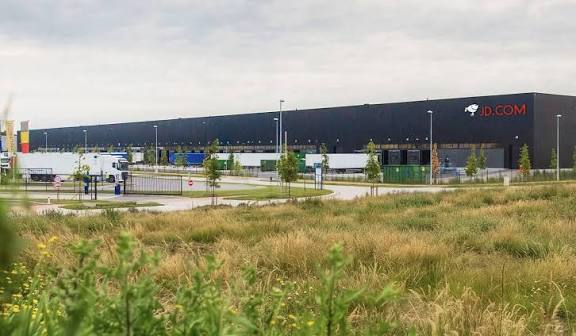
JD Logistics, the logistics arm of JD.com, has signed a long-term lease for nearly 48,000 square metres at Park De Hulst in Willebroek, between Antwerp and Brussels. Nothing ships from it yet. There is a signed lease, a stated intention to automate the building, and no published opening date. Read as a service change, it is nothing. Read as a mechanism, it is the most consequential thing a Chinese retailer has done in the Benelux this year.
Here is the distinction that matters for anyone selling into Europe. Temu and Shein sell into Europe from outside it. Their advantage is price, and it arrives on a cross-border parcel with a cross-border delivery time. JD is doing something different: putting inventory on European ground, inside the market it wants to serve. Local fulfilment is the step that converts a price advantage into a speed advantage, and a speed advantage is the one that touches your own delivery promise. Price competition happens on a product page. Delivery competition happens in the shipping estimate a shopper reads before they choose between you and someone else.
What was actually signed
The warehouse sits in Park De Hulst in Willebroek and was leased from the Belgian logistics property group Montea. It was developed in 2017, comprises 47,600 square metres of gross lettable area, and was previously occupied by Decathlon. Montea describes it as its largest single warehouse and among the ten biggest assets in a portfolio of 2,375,726 square metres across 124 locations as of 31 March 2026. The lease has been variously described as nearly 48,000 square metres and around 50,000 square metres; the underlying gross lettable area of the building is 47,600.
The stated purpose is to expand JD.com’s ecommerce operations in Belgium and Luxembourg. JD Logistics intends to equip the warehouse with a high degree of automation, tailored to the fast storage, processing and distribution of online orders. Intends is the operative word. The automation is a plan attached to a lease, not a running line.
Xavier Van Reeth, Country Director Belgium at Montea, framed the deal from the landlord’s side: “This agreement confirms that scarce, high-quality locations in Belgium continue to be in strong demand.” That is a property market comment, and it is also a useful signal about what JD paid for in strategic terms. Buildings of this size in this corridor are not easy to find, which means the choice of location was worth waiting for.

From the publisher
Everything we know about running Amazon, in one course.
The commercial strategy, taught by operators who run our own brands.
Why Willebroek is a decision, not a coincidence
Willebroek sits between the A12 and the E19 motorways, near the Brussels-Scheldt waterway and the Willebroek container terminal. That places it between Belgium’s largest port and its capital region, on the road spine that runs through the densest stretch of the Benelux.
Same-day and next-day delivery are geometry problems before they are technology problems. A promise like “order by 11:00, delivered today” is only credible if the stock is already within one van route of the customer. Put the building in the middle of the population and the promise becomes affordable. Put it at the edge and it does not, no matter how good the automation is. Willebroek is a bet on covering Belgian and Luxembourgish demand from a single point, and the fact that JD went looking for scarce space in exactly that corridor tells you the delivery clock was the specification.
When a competitor onshores fulfilment, the question is what each of your SKUs really costs to land and deliver. Sellerboard breaks true landed cost and fulfilment cost down to the individual SKU, so you can see which products can absorb a faster shipping promise and which ones cannot.
Affiliate link. E-CommSphere may earn a commission at no extra cost to you.
The shape of the build-out
One number on its own says very little. Put Willebroek next to what already exists and the pattern becomes readable.
When Joybuy launched across six European markets in March 2026 (the United Kingdom, Germany, France, Belgium, Luxembourg and the Netherlands), the network behind it was described as more than 60 warehouses and depots totalling over 300,000 square metres, plus more than 49,000 pickup points, served by JoyExpress and its own fleet of trucks, vans and electric bicycles. The delivery claim at launch was same-day delivery to 40 million consumers in urban areas for qualifying orders placed before 11:00.
The German anchor is a logistics centre in Oberhausen with more than 90,000 square metres of floor space. In Germany the service reaches over five million people in two million households in North Rhine-Westphalia, supported by more than 20,000 pick-up points and 100 parcel lockers nationally, with free same-day delivery from a minimum order value of 29 euros.
So the sequence reads: one very large hub for Germany’s industrial heartland at more than 90,000 square metres, and now a second at 47,600 square metres for Belgium and Luxembourg. Two countries with a combined population well under Germany’s get roughly half the footprint of the German site. That is not a token presence. It is a hub sized for a market JD intends to serve at speed, in a corridor chosen for density, added to a network that already had more than 300,000 square metres before Willebroek entered the picture.
Worth keeping in view: this is not JD arriving in Europe. Its predecessor brand Ochama ceased operations on 23 August 2025, and 19 European countries lost service in the process, leaving the six that Joybuy now covers. The footprint contracted before it grew. Willebroek is the growth phase of a retreat, which is a different story from a first landing, and it suggests JD concluded that fewer markets served properly beats many markets served thinly. Separately, JD’s acquisition of Ceconomy, the parent of MediaMarkt and Saturn, for 2.2 billion euros gives it a European retail estate that a Belgian hub can eventually feed, though that transaction is now the subject of its own regulatory fight.
Before you decide which shelf is worth defending, you need margin per channel, not margin in aggregate. Sellerboard splits profit by channel and by product so you can tell where a new local competitor actually costs you money and where it does not.
Affiliate link. E-CommSphere may earn a commission at no extra cost to you.
You cannot sell on this
This is the part most easily misread, so it is worth being blunt. Joybuy is not a marketplace you can join. At its March launch it positioned itself as a retailer selling its own inventory, explicitly differentiating itself from the marketplace model used by Temu, Shein and Alibaba. Its launch brands included Apple, Bosch, Sony, LG, LEGO, Philips and De’Longhi. European sellers cannot list products on it today, and no commission or fee schedule has been published.
A curated opening to selected third-party sellers from Europe and China is planned for the second half of 2026. Until terms exist, that is a plan, not a channel. Which means the Willebroek hub does not reach you as an opportunity. It reaches you as a competitor, in the form of a rival storefront that will be able to make a delivery promise in Belgium and Luxembourg that is fulfilled from inside Belgium.
The customs clock is running in the same direction
There is a regulatory reason onshore stock is worth building right now. From 1 July 2026 the EU applies a temporary flat customs duty of 3 euros per item on consignments valued up to 150 euros, charged per item according to tariff classification. It runs until 1 July 2028, when the EU Customs Data Hub for ecommerce is expected to be operational.
That charge falls on the cross-border parcel. It does not fall on an order picked from a warehouse in Willebroek. Every retailer whose European economics depended on cheap direct shipping from Asia now has a reason to move stock inside the customs border, and the ones with the capital to lease 47,600 square metres are the ones that can. The customs change and the fulfilment build are the same strategy viewed from two angles.
What actually changes for a European seller
In the short term, nothing measurable. No Belgian delivery window moved this month, because the building is not running. Treating this as a live threat to next week’s conversion rate would be a misreading.
In the medium term, the variable to watch is not JD’s price. It is JD’s cut-off time in the Benelux, because that is the number that lands next to yours in a shopper’s basket. The open questions the lease leaves behind are specific: when Willebroek starts operating, whether Benelux order cut-offs tighten to match the German pattern, whether the curated third-party opening comes with terms a European brand would accept, and how much of your own catalogue overlaps the first-party assortment JD chooses to stock locally. Those four answers, not the square metre count, determine whether this warehouse ever appears in your numbers.
The broader point stands regardless of timing. The competitive frontier in European ecommerce is moving from who can sell cheapest into the continent to who can deliver fastest inside it. A lease in Willebroek is what that shift looks like on paper before it looks like anything on a delivery estimate.
Sources
- RetailDetail EU, “Chinese e-commerce giant JD.com opens a distribution center in Belgium” (18 August 2026) – https://www.retaildetail.eu/news/general/chinese-e-commerce-giant-jd-com-opens-a-distribution-center-in-belgium/
- Europe Real Estate, “China’s largest retailer, JD.com, signs long-term lease for 50,000 m2 with Montea in Belgium” – https://europe-re.com/china-s-largest-retailer-jd-com-signs-long-term-lease-for-50-000-m-with-montea-in-belgium/74646
- Transportmedia, “Montea verhuurt 47.600 m2 in Willebroek aan JD.com” – https://transportmedia.be/2026/08/montea-verhuurt-47-600-m2-in-willebroek-aan-jd-com/
- RetailDetail EU, “Joybuy launches European offensive as a challenger to Amazon and Bol” (16 March 2026) – https://www.retaildetail.eu/news/general/joybuy-launches-european-offensive-as-a-challenger-to-amazon-and-bol/
- E-Commerce Institut, “Joybuy market entry Germany 2026, same-day delivery” (20 March 2026) – https://ecommerceinstitut.de/joybuy-market-entry-germany-2026-same-day-delivery/
- RetailDetail EU, “Joybuy plans to open its marketplace to third-party sellers” – https://www.retaildetail.eu/news/general/joybuy-plans-to-open-its-marketplace-to-third-party-sellers/
- Ecommerce News Europe, “Joybuy live in France, Germany coming soon” – https://ecommercenews.eu/joybuy-live-in-france-germany-coming-soon/
- European Commission, Taxation and Customs Union, “Guidance and legal text on temporary flat fee on low-value imports which will apply until 1 July 2028” (8 June 2026) – https://taxation-customs.ec.europa.eu/news/guidance-and-legal-text-temporary-flat-fee-low-value-imports-which-will-apply-until-1-july-2028-2026-06-08_en