

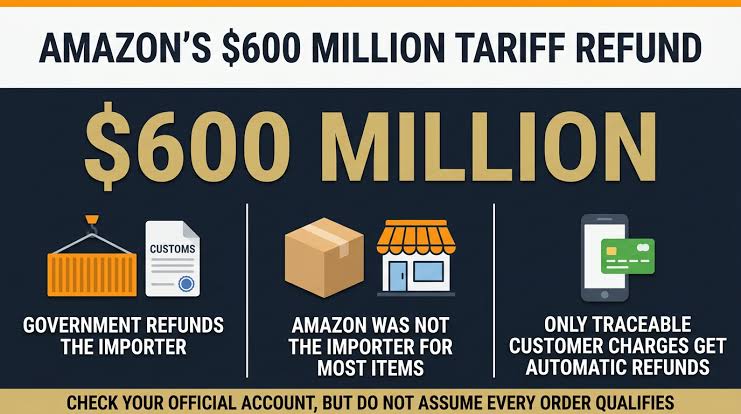
Amazon received about $600 million in tariff refunds in the second quarter, and it will hand money back to shoppers only in the narrow cases where it can trace a specific import charge to what a specific customer paid. Everything else goes into lower prices. The part that matters to sellers sits inside the explanation of why the figure was so small: Amazon is not the importer of record on most of what sells in its store, because outside sellers are. That single fact reassigns the whole refund. On marketplace goods the claim is the seller’s to file with U.S. Customs, not Amazon’s to pass along. Amazon has collected. If your name was on the entry paperwork, nobody is collecting on your behalf, and the company has now said so as plainly as a CFO can.
What Amazon actually said
CFO Brian Olsavsky disclosed the $600 million on the second-quarter earnings call on 30 July. The refunds stem from a February Supreme Court ruling that struck down the broad tariffs imposed under the International Emergency Economic Powers Act of 1977, which obliged the government to return duties to the companies that had paid them.
On what reaches shoppers, Olsavsky was specific: “We have identified a limited set of circumstances where we can trace that we passed specific import charges on to customers, and when we receive those refunds, we will proactively contact affected customers and automatically issue refunds to them.” Amazon’s finance chief framed it as an intention to reimburse shoppers if possible, with refunds issued automatically where a specific import charge can be traced to an individual order. Outside those cases, Amazon will use the money to keep investing in low prices.
Read that as an operator rather than a shopper and the shape is clear. This is not a compensation programme. It is a reconciliation exercise limited to orders where Amazon itself paid the duty and can prove it flowed into the price a customer was charged.

From the publisher
Everything we know about running Amazon, in one course.
The commercial strategy, taught by operators who run our own brands.
Why $600 million is small for a company this size
Two reasons, and both are seller-relevant. The first is timing: Amazon bought heavily before the tariffs took effect, so much of what it sold during the tariff window had already cleared customs at the old rate. Less duty paid, less duty to reclaim.
The second is structural. In Olsavsky’s words, Amazon is “not the importer of record for the large majority of items sold in our store given suppliers typically handle imports and pay relevant tariffs.” Outside sellers account for more than 60% of goods sold on Amazon’s marketplace. Many of those third-party sellers import from overseas and were forced to raise prices because of the tariffs. In many cases it was the seller, not Amazon, who paid the duty at the border, which is exactly what makes tracing a refund back to an individual shopper complicated.
So the marketplace’s biggest cost shock in two years was absorbed, in the majority of cases, by the people whose names are on the customs entries. The refund follows the same paperwork.
You cannot size a refund you cannot measure. Sellerboard rebuilds net margin per SKU from your Amazon settlement data, landed cost and duties included, so your tariff-era units stay separate from the rest.
Affiliate link. E-CommSphere may earn a commission at no extra cost to you.
The refund belongs to the importer of record, and only to them
What follows is United States tariff and customs mechanics. It applies to goods you imported into the U.S. and duties paid to U.S. Customs and Border Protection. It is not how a European seller recovers duty, and we come back to that below.
CBP built a dedicated channel for these refunds. On 20 April 2026 it launched the first phase of CAPE, the Consolidated Administration and Processing of Entries tool, which lets an importer of record or its authorised customs broker submit a single electronic declaration. Phase 1 is limited in scope: certain unliquidated entries, and certain entries liquidated within 80 days.
The eligibility rule is the whole story for marketplace sellers. Per BDO’s guidance for importers, only the importer of record that originally paid the IEEPA tariffs is eligible to file claims through CAPE Phase 1. Other parties in the chain who absorbed the cost do not hold a claim of their own; they hold a commercial negotiation with the importer of record. Where a different party is meant to receive the money, the importer of record must designate it on CBP Form 4811 in the ACE portal before the CAPE declaration is submitted, and BDO notes that once an entry has gone in under CAPE, post summary corrections are no longer permitted and CBP will not add a notify party afterwards. BDO also states that post summary corrections should not be used to claim IEEPA refunds on unliquidated entries, that accepted claims have been running at roughly 60 to 90 days, and that protests can be filed within 180 days of final liquidation to preserve rights on entries outside Phase 1.
Three consequences follow.
- If your entries name you as importer of record, the claim is yours and it will not file itself. Amazon collecting $600 million tells you nothing about your own entries.
- If a supplier or forwarder is the importer of record on your goods, you absorbed the cost without holding the claim. That is a contract conversation, and the designation must exist before their declaration goes in.
- Sequencing errors are expensive. Doors close once an entry is submitted, so the first task is establishing which of your entries are unliquidated and which are past the windows.
A refund claim is only as good as your record of what you paid, per shipment. Track cost of goods as one flat number per ASIN and you cannot separate the units that carried duty from the ones that did not. Sellerboard keeps it batch-level, so a mid-year cost change survives and you have a per-shipment view to hand a customs broker.
Affiliate link. E-CommSphere may earn a commission at no extra cost to you.
If you sell in Europe, this is a parallel, not the same process
The refund wave above exists because a U.S. court struck down a U.S. tariff instrument, and it is administered by U.S. Customs and Border Protection. There is no European version of that ruling and no European CAPE.
The parallel that does exist is the EU’s own duty repayment route. Under the Union Customs Code, national customs authorities decide whether a customs debt should be repaid or remitted, and one of the grounds is overcharged amounts of duty under Article 117 UCC. Article 121(1) requires applications for repayment or remission to be submitted to the customs authorities within three years of the date of notification of the customs debt where the ground is overcharged duty, error by the competent authorities or equity. The structural logic matches, the declarant applies to the customs authority and the marketplace is not involved, but the legal basis, the forms, the deadlines and the deciding authority are different. Do not read a U.S. CAPE timeline as anything that applies to a Dutch, German or Spanish import.
What the other big retailers are doing with theirs
Amazon is not an outlier in keeping most of the money. Walmart said it would prioritise using the proceeds to invest in prices. Costco indicated it intends to pass at least some of its refund money back to customers. Apple said its earnings per share were lifted by 11 cents by tariff refunds in its third quarter.
Refunds are being treated as balance-sheet relief and pricing ammunition, not restitution. For a marketplace seller that has a competitive edge to it: retail-side competitors are being handed room to cut prices at the moment your own refund is still an unfiled claim.
The next round is already in motion
The legal ground is still moving. On 23 July, Trump announced the United States would apply taxes of 10% to 12.5% on imports from 60 countries accounting for 99% of U.S. imports, and those measures have drawn legal challenges arguing the administration exceeded its authority. The disclosure also lands in the middle of litigation: a class action alleged Amazon was not seeking refunds in order to curry favour with Trump, and confirming that it both sought and received them speaks to that claim without ending the cases. No class has been certified and Amazon has not been found liable.
The takeaway is not to predict the courts. It is that the last tariff cycle produced recoverable money for whoever held the entry paperwork, and the next one is being built on the same principle.
What to do this week
- Read the importer of record field on your entry summaries. That name, not your supplier invoice, decides who owns the claim.
- Ask your customs broker which of your IEEPA entries are unliquidated, and which liquidated in the last 80 days. Those are the ones CAPE Phase 1 reaches.
- If someone else is importer of record on your goods, open the Form 4811 conversation now, because the designation must exist before their declaration is filed.
- Diarise the 180-day post-liquidation protest window for entries outside Phase 1.
- Stop waiting for a Seller Central announcement. Amazon’s commitment covers orders where Amazon paid the import charge, and on marketplace goods that is usually not Amazon.
Amazon spent one line of an earnings call explaining that more than 60% of the goods in its store are imported by somebody else. Read as a shopper, that line excuses a small refund. Read as a seller, it is notice that the refund on your inventory has your name on it, and that nobody else is going to go and get it.
Sources
- Fortune, “Amazon may owe you money: It just got $600 million in tariff refunds after a lawsuit accused it of favoring Trump” https://fortune.com/2026/07/31/amazon-600-million-tariff-refunds-wallet-lawsuit-bezos-trump/
- Scripps News, “Amazon to reimburse some tariff costs after receiving $600 million in refunds” https://www.scrippsnews.com/us-news/amazon-to-reimburse-some-tariff-costs-after-receiving-600-million-in-refunds
- Open Class Actions, “Amazon Got $600M in Tariff Refunds and Will Refund Some Shoppers” https://openclassactions.com/news/amazon-600-million-tariff-refund-customer-refunds.php
- BDO, “IEEPA Tariff Refund: Key FAQs for Importers” https://www.bdo.com/insights/tax/ieepa-tariff-refunds-frequently-asked-questions
- White and Williams LLP, “IEEPA Tariff Refunds: CBP Launches CAPE Process” https://www.whiteandwilliams.com/resources-alerts-IEEPA-Tariff-Refunds-CBP-Launches-CAPE-Process
- European Commission, Taxation and Customs Union, “Customs debt: remission and repayment” https://taxation-customs.ec.europa.eu/customs/customs-procedures-import-and-export/customs-operations/customs-debt-remission-and-repayment_en
- Union Customs Code, Regulation (EU) No 952/2013, Title III Chapter 3, Articles 116 to 121 https://www.legislation.gov.uk/eur/2013/952/title/III/chapter/3
 Erene Araojo