

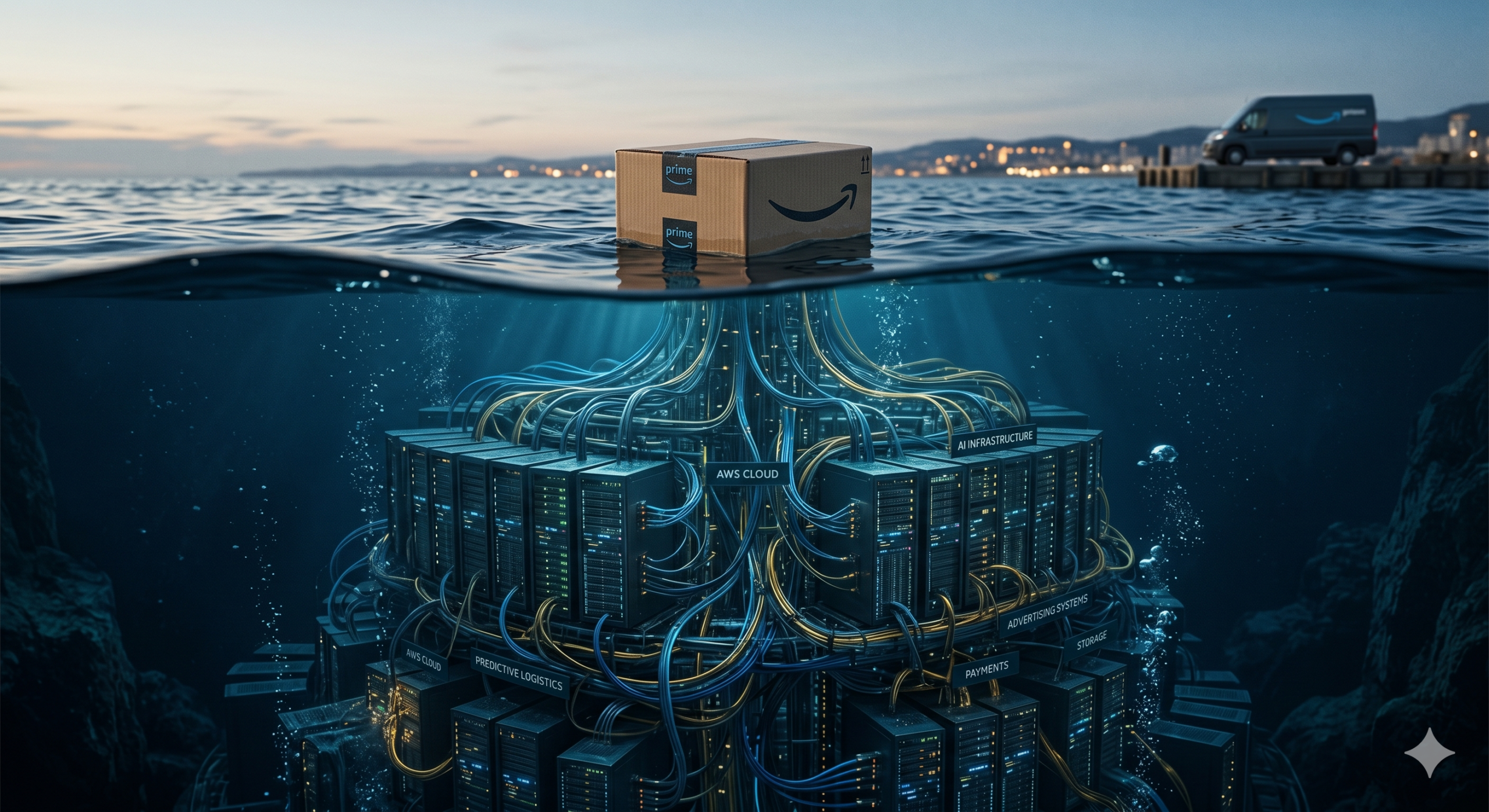
For years, Amazon was viewed primarily as an eCommerce giant—a company that sold products online faster and more efficiently than anyone else.
But that description no longer captures what Amazon has become.
Today, Amazon is evolving into something much larger:
👉 an infrastructure company.
Its real business is no longer just retail.
It is building the systems that modern commerce increasingly depends on.
Retail Was Only the Beginning
Amazon started with books.
Then came:
- marketplaces
- Prime
- fulfillment
- cloud computing
- advertising
- AI infrastructure
Each expansion seemed separate at first.
But together, they reveal a much bigger strategy:
👉 owning the operational layers behind digital commerce.
Amazon Powers More Than Shopping
Amazon now operates infrastructure across multiple industries:
- AWS powers large parts of the internet and AI workloads
- Fulfillment networks support millions of sellers
- Advertising systems shape product visibility
- Logistics operations rival global carriers
- AI systems increasingly influence discovery and recommendations
At this point, many businesses don’t just sell through Amazon.
They operate on top of Amazon infrastructure.
The Operating System of Commerce
The most important shift is that Amazon increasingly behaves like:
👉 an operating system for commerce.
It provides:
- storage
- distribution
- payments
- cloud computing
- advertising
- customer acquisition
- AI-powered recommendations
This creates deep dependency.
Sellers may own products—but Amazon controls much of the environment where those products compete.
Infrastructure Creates Power
Infrastructure businesses are powerful because they become difficult to replace.
Once companies rely on:
- AWS
- FBA
- Amazon Ads
- Amazon logistics
switching becomes expensive and operationally complex.
This gives Amazon an advantage beyond retail margins:
👉 ecosystem control.
Why AI Makes Amazon Even Stronger
Artificial intelligence is accelerating this transition.
As Amazon integrates:
- conversational search
- AI shopping assistants
- predictive logistics
- automated fulfillment
it strengthens every layer of its infrastructure.
AI doesn’t just improve the customer experience.
It makes Amazon’s ecosystem:
- smarter
- faster
- more efficient
- more difficult to compete with.
Competitors Face a Bigger Problem
Most companies still think they compete with Amazon in retail.
But the real challenge is broader:
👉 Amazon competes at the infrastructure level.
Retailers may compete on:
- products
- pricing
- branding
while Amazon controls:
- fulfillment systems
- recommendation engines
- delivery expectations
- cloud infrastructure
That’s a very different type of competitive position.
The Bigger Shift
What’s happening reflects a broader transformation in the digital economy:
- platforms become infrastructure
- infrastructure becomes dependency
- dependency creates ecosystem power
Amazon is no longer simply selling products.
It is increasingly selling:
👉 operational capability.
Final Thought
The future of Amazon may have less to do with retail itself and more to do with becoming the foundation that modern commerce runs on.
Because the companies with the most power in the next decade may not be the ones selling the most products—
but the ones controlling the systems everyone else depends on.
And Amazon is building exactly that.

From the publisher
Everything we know about running Amazon, in one course.
The commercial strategy, taught by operators who run our own brands.