

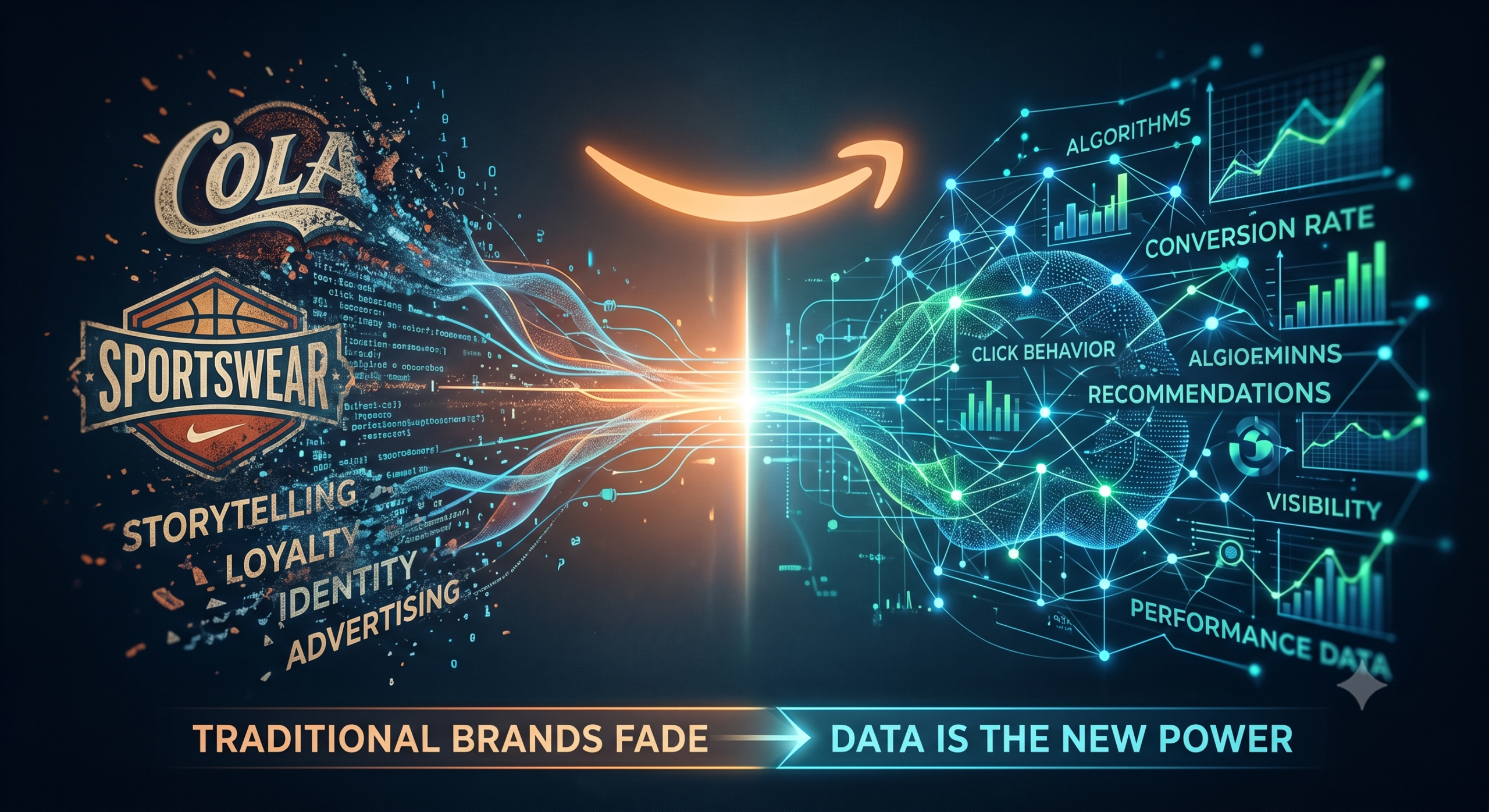
For decades, brands controlled consumer relationships.
Companies invested billions into:
- advertising
- packaging
- loyalty
- storytelling
- brand identity
The goal was simple:
👉 make customers remember the brand.
But on Amazon, something fundamental has changed.
Increasingly, Amazon—not the brand—controls:
- visibility
- discovery
- recommendations
- customer attention
- purchasing behavior
And that shifts power away from traditional branding toward:
👉 data and algorithms.
The Marketplace Changed the Rules
In traditional retail:
- brands fought for shelf space
In eCommerce:
- brands fought for search rankings
On Amazon:
👉 algorithms increasingly decide what consumers see.
Customers often:
- compare products quickly
- trust Amazon recommendations
- choose based on ratings, pricing, and convenience
Brand loyalty becomes weaker when the platform controls discovery.
Data Becomes More Valuable Than Branding
Amazon collects enormous amounts of data:
- click behavior
- conversion rates
- customer preferences
- purchase history
- pricing sensitivity
This gives Amazon a deep understanding of:
👉 what consumers actually buy—not just what brands want to communicate.
The result:
performance data increasingly matters more than emotional branding.
The Rise of Algorithmic Commerce
As Amazon integrates more AI into:
- search
- recommendations
- advertising
commerce becomes increasingly algorithmic.
Products succeed because:
- the system recommends them
- conversion rates are strong
- fulfillment is fast
- reviews reinforce trust
Not necessarily because customers deeply know the brand itself.
This creates a world where:
👉 optimization matters more than identity.
Sponsored Visibility Changes Everything
Amazon Ads accelerated this shift even further.
Visibility is no longer determined only by:
- reputation
- market share
- brand recognition
It is heavily influenced by:
- bidding systems
- conversion efficiency
- data signals
This creates a marketplace where:
👉 performance marketing becomes central to survival.
Amazon Owns the Consumer Relationship
Perhaps the biggest shift is this:
most brands selling on Amazon do not truly own the customer relationship.
Amazon controls:
- customer data
- transaction flow
- recommendation systems
- post-purchase interactions
Brands gain reach—but lose direct connection.
That changes the balance of power dramatically.
Why This Matters
This transformation affects the future of commerce itself.
Brands increasingly compete in a world where:
- algorithms mediate visibility
- AI shapes discovery
- marketplaces control traffic
The strongest products may not always be the most recognizable brands—
but the ones best optimized for platform systems.
The Bigger Shift
Amazon reflects a broader evolution happening across digital commerce:
- branding becomes data-driven
- visibility becomes algorithmic
- platforms become gatekeepers
This doesn’t mean brands disappear.
But it does mean that:
👉 controlling distribution and recommendation systems may become more powerful than traditional advertising alone.
Final Thought
Amazon is quietly redefining what branding means in the digital era.
The future may belong less to the companies with the biggest logos—
and more to the companies that best understand:
- data
- algorithms
- conversion systems
- and platform dynamics.
Because in modern commerce, visibility is increasingly earned not through branding alone—
but through machine-driven performance.

From the publisher
Everything we know about running Amazon, in one course.
The commercial strategy, taught by operators who run our own brands.
 Erene Araojo