

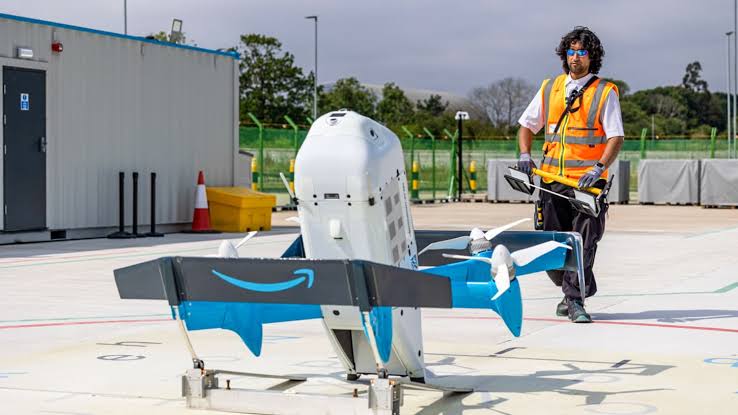
Amazon is now delivering parcels by drone to customers in Darlington, England, the first Prime Air site anywhere outside the United States. The interesting part for sellers is not the aircraft. It is that a European aviation regulator has cleared routine commercial drone delivery to private homes, and that the goods it can carry are precisely the small, light, urgent items where impulse buying and convenience pricing live.
Read the boundaries before you read the headline. Prime Air in the UK is currently available to customers with a garden, yard, or driveway in a 7.5 mile (12km) radius of the Darlington fulfillment center. That is one building, one circle, and one set of eligible households inside it. This is not national coverage, it is not regional coverage, and anyone selling it to you as a UK rollout is selling you something Amazon has not said.
What it is is a first site with a regulator’s signature on it. That signature is the thing that travels.
What is actually live
The service began flying to customers in February 2026. The confirmed envelope:
- Coverage: a 7.5 mile (12km) radius of the Darlington fulfillment center, a 465,000 square foot site a few miles from the town centre.
- Household requirement: the customer needs a garden, yard, or driveway. No outdoor drop zone, no drone delivery.
- Weight and size: when an item weighs 5lbs (2.2kg) or less and fits into a large shoebox, the customer can select the drone delivery option during checkout.
- Speed: as in the US, deliveries in the UK are made within 60 minutes or less of the order being placed.
- Regulatory status: the drone has received Civil Aviation Authority approval to conduct operations.
- Price to the customer: currently included as part of an Amazon Prime membership with no additional delivery fee for members.
- Catalogue scope: Amazon says millions of items are currently eligible. It has not published a category list.
The aircraft is the MK30, cruising at up to 70mph, and Amazon says it logged more than 5,100 test flights and over 900 hours in the air before carrying a customer package in either country. Those are the least useful facts in this story.

From the publisher
Everything we know about running Amazon, in one course.
The commercial strategy, taught by operators who run our own brands.
The precedent is the story
Amazon first said it wanted Prime Air in the UK in 2023 and confirmed Darlington in 2025, after assessments of population density, airspace complexity and existing infrastructure. The gap between announcing a hub and flying one was never about engineering. It was about two permissions: local planning consent for the ground facilities, and CAA clearance to fly in British airspace.
PPC Land’s read on the regulatory dimension is the one operators should borrow: the approval process Darlington required, covering flight corridors, obstacle avoidance systems, and community consultation, establishes a template that other companies pursuing UK drone delivery will need to navigate. Once a first mover has walked a regulator through a novel operation and come out with an approval, the applications behind it are cheaper and better understood by everyone in the room.
So the question is not whether drones will deliver your product next quarter. Almost certainly they will not. It is what happens to buyer expectations in Britain if the shortest, most visible delivery promise on the largest marketplace stops being paid for.
Before you have an opinion on drones, find out how much of your catalogue is actually under 2.2kg and shoebox sized. Helium 10’s product and keyword data lets you pull weight, dimensions and demand across your own ASINs and your competitors’, so you can see which of your categories sit in the small, light and urgent profile instead of guessing. Code ECOMMGM10.
Affiliate link. E-CommSphere may earn a commission at no extra cost to you.
A large shoebox under 2.2kg is a category filter
Amazon has not published which products qualify, only the physical envelope and the claim that millions of items are eligible. But the envelope is descriptive. Five pounds and a large shoebox is the shape of supplements, skincare, phone and cable accessories, batteries, over the counter health items, pet treats, small tools, replacement parts and the forgotten ingredient. It is the shape of almost everything bought because it is needed now rather than planned for.
That is not a coincidence of physics, it is the commercial logic of the service. Sub-hour delivery only pays for itself where urgency is the reason for the purchase, and urgency is concentrated in exactly the cheap, light, replaceable categories where thousands of third party sellers compete on price and Prime badge alone.
If your catalogue lives there, you are in the affected set. Not affected today, in Darlington, at your volumes. Affected in the sense that the fulfilment promise attached to your category is being redefined above your head, by a party that owns both the marketplace and the aircraft.
What happens to your price when speed stops being a premium
Here is the pricing fact worth circling. In the UK, drone delivery is bundled into Prime at no extra charge to the member, and Amazon’s stated position is that as it extends the service to broader areas it will evaluate delivery fees consistent with its other premium speed services. PPC Land notes the contrast with some US locations, where drone delivery has carried per order charges for Prime and non Prime customers depending on the market.
Two readings, and both are uncomfortable for a small seller.
If the fee stays at zero, sixty minutes becomes a free feature of membership rather than a paid upgrade. Every merchant whose margin quietly depends on customers paying for speed, or tolerating three days because fast costs extra, loses that cushion. Expedited shipping stops being a revenue line and becomes a baseline expectation.
If a fee arrives later, that is worse in a different way, because customers will have spent a year learning that an hour is normal before anyone attaches a price to it. Expectations reset faster than they un-reset.
Either way the operator action is arithmetic, not strategy. On your small and light SKUs, you need to know what the unit economics look like if the speed premium goes to zero and the only remaining differentiators are price, reviews and availability. Most sellers do not know that number, because their margin reporting stops at gross and never lands fulfilment, storage, return and advertising cost on the individual SKU.
If speed stops being something customers pay extra for, your margin on small light items has to survive on its own. Sellerboard lands real fees, FBA costs, returns, storage and ad spend on each individual SKU, so you can see today which of your low weight products still make money once the delivery premium is gone.
Affiliate link. E-CommSphere may earn a commission at no extra cost to you.
Where the ceiling genuinely binds
Now the case against overreacting, because several of these constraints are structural rather than temporary.
The household requirement is a hard filter. Flats, terraces without private outdoor space and shared access properties are out by design, which excludes a large share of exactly the dense urban demand that makes sub-hour delivery commercially interesting. At checkout, customers see a satellite map of their property with pre identified delivery zones, mapped digitally with no physical survey needed, and pick a drop point they then keep clear.
Weather is the second binding limit, and Amazon has been honest about it. The MK30 can fly in light rain and a range of temperatures and wind speeds, but real time weather signals are built into the checkout: if conditions are unsuitable, drone delivery does not appear as a shipping option at all and the customer picks another method. In Britain that is not a footnote. It makes drone delivery an intermittent option rather than a guaranteed service level, and a promise that vanishes on wet days cannot yet be the backbone of anyone’s fulfilment expectations.
Third, throughput. This is one fulfilment centre serving one radius, and Amazon has not made public how many flights per day the site handles.
Set against that, the ambition is not hidden. Prime Air’s chief project engineer, Stephen Wells, said of the MK30 that it was “the first drone we have developed from the ground up using a requirements-based process including more stringent requirements that will allow us to eventually reach a half billion customers annually.” That is a target, not a capability. But a company does not build to half a billion customers in order to serve the gardens of one Teesside town.
What we would do this quarter
- Segment your catalogue by the envelope. Tag every SKU under 2.2kg that fits a large shoebox. That percentage is your exposure number.
- Model the zero premium case. Run those SKUs at true net margin assuming no customer pays anything for speed. If a product only works because fast shipping is a paid tier, it is a fragile product.
- Stop selling speed you do not control. On small light items, differentiation has to come from what Amazon cannot bundle into Prime: the product, the bundle, the brand, the repeat purchase.
- Watch the fee decision, not the flight count. Amazon has said it will evaluate delivery fees as the service extends to broader areas. That is the sentence that moves your P&L.
The bottom line
One fulfilment centre, a 7.5 mile circle, households with a garden, yard or driveway, items of 5lbs (2.2kg) or less that fit a large shoebox, sixty minutes or less, free to Prime members for now, and a CAA approval underneath all of it. Treat the first six facts as scope and the seventh as the news. The scope says relax. The approval says start doing the arithmetic on your small, light and urgent lines, because speed is on its way to becoming table stakes rather than a thing you charge for.
Sources
- About Amazon, “Inside Amazon’s first-ever drone delivery site in the UK”
- PPC Land, “Amazon Prime Air drones reach UK customers within 7.5-mile radius”, 9 August 2026
 Jorge Callejo