

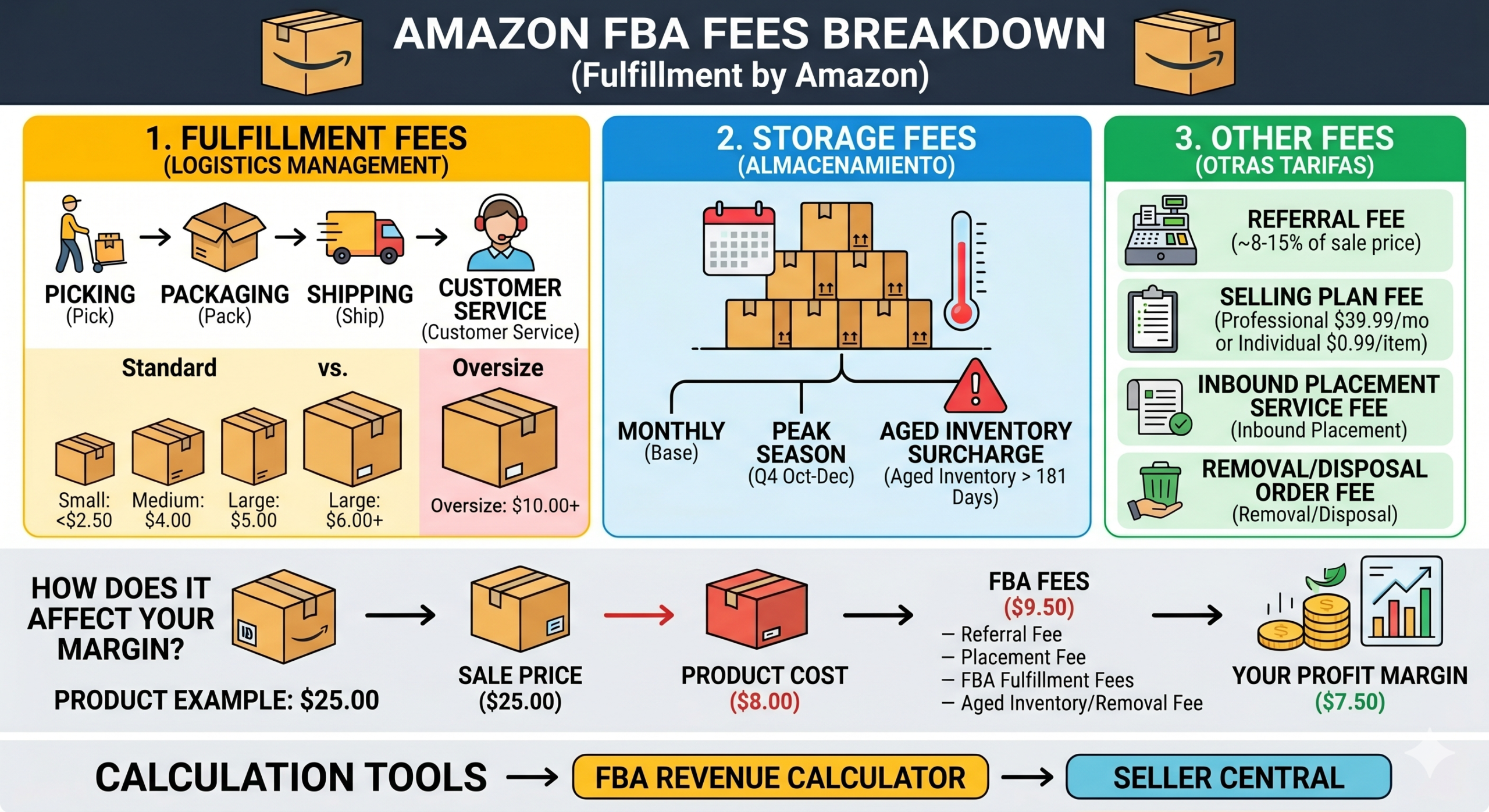
Amazon’s FBA fees look simple when you start selling. Then Amazon adds fulfillment fees, storage fees, returns processing, inbound placement charges, and random-looking surcharges that quietly eat your margin.
Most sellers don’t lose money because of one giant fee. They lose it because ten smaller fees stack together until the math stops working.
Here’s the breakdown of the main Amazon FBA fees sellers need to understand in 2026.
TL;DR
- Amazon FBA fees now go way beyond the standard 15% referral fee.
- Storage and aged inventory fees are where sellers quietly get crushed.
- Amazon raised average fulfillment fees by about $0.08 per unit in 2026 (Seller Central, as of May 2026).
- A 3.5% fuel and logistics surcharge also applies to US and Canada FBA fulfillment fees (Seller Central, as of May 2026).
- If you’re only tracking revenue and PPC, your profit numbers are probably wrong.
1. Referral Fees
Referral fees are Amazon’s commission on each sale.
As of May 2026:
- Apparel products: 17% referral fee (Amazon Seller Pricing)
- Most Home & Kitchen products: 15% (Amazon Seller Pricing)
- Some electronics categories: as low as 8% (Amazon Seller Pricing)
This fee applies whether you use FBA or FBM.
A lot of sellers stop here when calculating margins. Big mistake.
2. FBA Fulfillment Fees
This is the fee Amazon charges to pick, pack, and ship your product.
The cost depends on:
- Product size
- Weight
- Dimensional weight
- Apparel vs non-apparel
- Dangerous goods classification
Amazon confirmed average fulfillment fee increases of about $0.08 per unit for 2026 (Seller Central, as of May 2026).
Cheap, lightweight products still have an advantage. Heavy or bulky products get punished fast.
3. Storage Fees
Amazon charges monthly storage fees based on how much warehouse space your inventory uses.
The important part: Q4 storage pricing gets dramatically more expensive.
Amazon wants fast-moving inventory. Slow inventory gets expensive quickly.
This is where sellers start paying “rent for indecision.”
See also: [link to forthcoming “How to reduce Amazon storage fees” how-to].
4. Aged Inventory Surcharges
If inventory sits too long inside Amazon warehouses, Amazon adds extra penalties.
Historically, surcharge thresholds started at 271 days and increased again after 365 days (Seller Central, as of May 2026).
This fee category destroys margins for sellers who over-order inventory.
Every experienced Amazon operator eventually learns the same lesson:
Bad inventory decisions get more expensive every month.
5. Returns Processing Fees
Amazon also charges returns processing fees in high-return categories like:
- Apparel
- Shoes
- Jewelry
- Watches
- Luggage
Returns hurt twice:
- The processing fee
- Unsellable or damaged inventory
Apparel sellers already build this into pricing. Most newer sellers don’t.
6. Inbound Placement Fees
Amazon now charges sellers based on how inventory is distributed across fulfillment centers.
If Amazon handles the distribution internally, sellers pay inbound placement fees.
You can reduce costs by splitting shipments yourself, but operational complexity goes up.
Amazon is basically charging for convenience.
7. Fuel and Logistics Surcharge
Amazon added a 3.5% fuel and logistics surcharge for US and Canada FBA fulfillment fees beginning April 17, 2026 (Seller Central, as of May 2026).
The surcharge applies to fulfillment fees, not the product price.
Temporary Amazon surcharges have a habit of sticking around longer than expected. Sellers should model this one as permanent until proven otherwise.
Simple Margin Example
Here’s how a $29.99 product can break down:
| Fee Type | Cost |
| Referral fee | $4.50 |
| Fulfillment fee | $4.20 |
| Fuel surcharge | $0.15 |
| Storage allocation | $0.32 |
| PPC spend | $6.00 |
Before product cost, you’re already around $15 in expenses.
That’s why revenue screenshots without profit context are mostly meaningless.
Tools to Track FBA Fees
Spreadsheets work early on. Then Amazon changes another fee structure and the formulas quietly stop reflecting reality.
Tools like Sellerboard help sellers track:
- FBA fees
- PPC costs
- Returns
- Refunds
- Storage fees
- Real SKU-level profit
For more, see [link to forthcoming “Best Amazon profit tracking tools” roundup].
Final Thought
Amazon’s fee structure is designed to reward operational efficiency.
Fast-moving inventory, tighter packaging, lower return rates, and cleaner forecasting all get rewarded. Slow-moving inventory gets punished aggressively.
The sellers who survive long-term usually stop thinking about FBA fees as “Amazon deductions” and start treating them like a core part of inventory strategy.

From the publisher
Everything we know about running Amazon, in one course.
The commercial strategy, taught by operators who run our own brands.