

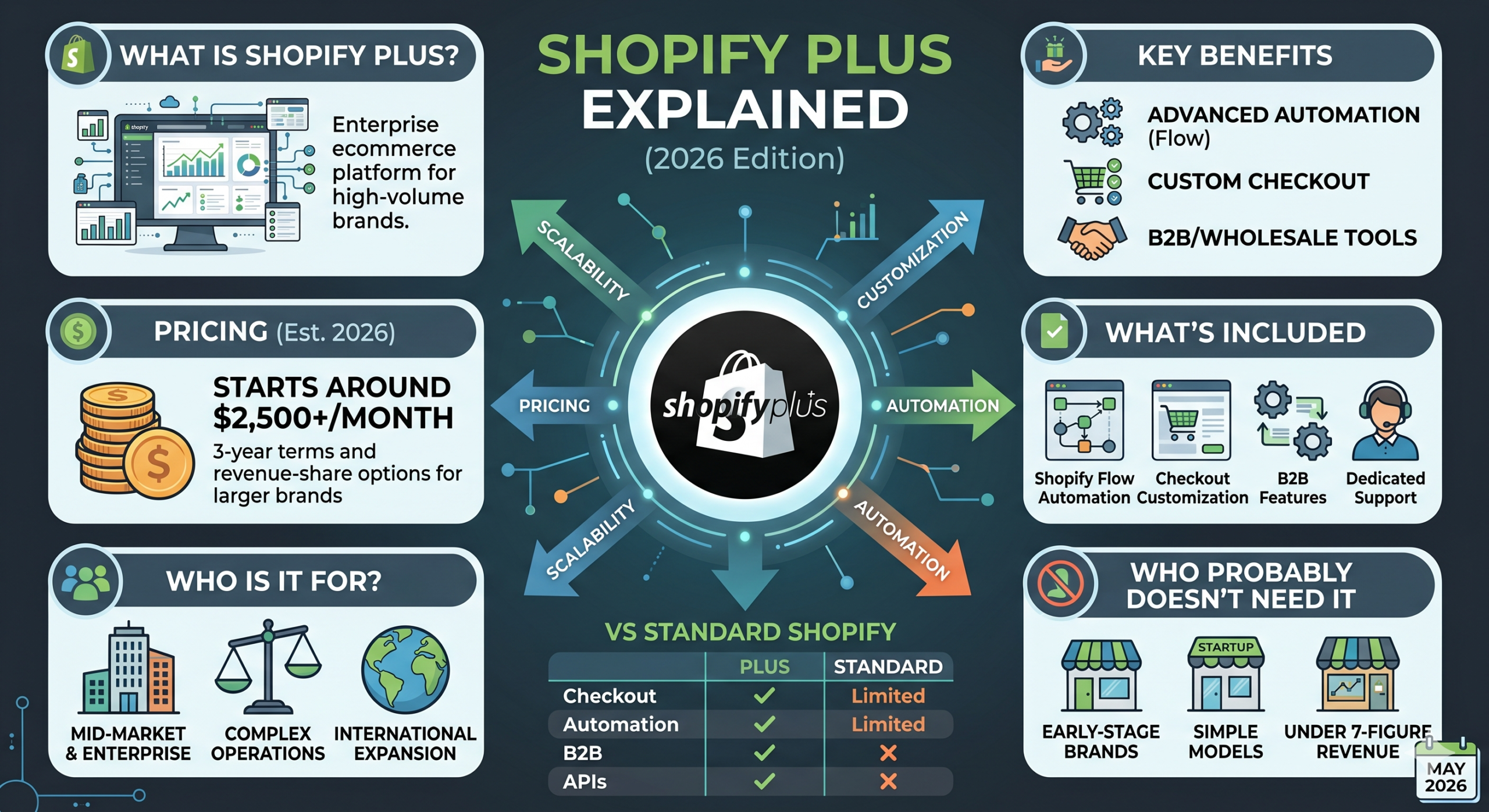
Shopify Plus is Shopify’s enterprise ecommerce platform for larger brands doing serious volume.
The simple version: it’s Shopify with more customization, better automation, deeper B2B features, higher API limits, and enterprise-level support.
The less simple version is that most brands don’t actually need it yet.
A lot of operators move to Shopify Plus because they think it unlocks growth automatically. Usually what it really unlocks is more operational flexibility — which only matters if your business is already hitting the limits of standard Shopify plans.
Here’s what Shopify Plus actually includes, what it costs, and who it makes sense for in 2026.
TL;DR
- Shopify Plus is Shopify’s enterprise plan built for higher-volume brands and complex operations.
- Pricing starts around $2,500/month on a 3-year term (Shopify Plus, as of May 2026).
- The biggest advantages are automation, checkout customization, B2B tools, and higher scalability.
- Most brands under seven figures in annual revenue probably don’t need it yet.
- Shopify Plus solves operational bottlenecks. It does not magically fix bad products or weak acquisition.
What Is Shopify Plus?
Shopify Plus is the enterprise version of Shopify designed for brands with larger catalogs, higher order volume, international operations, wholesale programs, or more advanced technical requirements.
Compared to standard Shopify plans, Shopify Plus offers:
- More customization
- Advanced automation tools
- Higher API capacity
- Wholesale/B2B functionality
- Multi-store management
- Custom checkout capabilities
- Dedicated account support
Think of normal Shopify as “plug-and-play ecommerce.”
Shopify Plus is closer to infrastructure.
How Much Does Shopify Plus Cost?
As of May 2026, Shopify Plus pricing starts at approximately $2,500 per month on a standard 3-year term (Shopify Plus).
Shorter contracts can cost more.
For enterprise brands doing very large GMV, pricing can shift into revenue-share structures depending on negotiated agreements.
This is where a lot of founders get surprised.
The platform cost itself usually isn’t the expensive part. The expensive part is everything you start adding after moving to Plus:
- Developers
- Agencies
- Custom apps
- Systems integrations
- ERP connections
- International expansion workflows
Shopify Plus is rarely a “set it and forget it” upgrade.
What Features Does Shopify Plus Include?

From the publisher
Everything we know about running Amazon, in one course.
The commercial strategy, taught by operators who run our own brands.
1. Checkout Customization
One of the biggest reasons brands move to Shopify Plus is checkout control.
Standard Shopify plans limit checkout customization heavily. Shopify Plus allows deeper edits through Checkout Extensibility and Shopify Functions (Shopify Help Center, as of May 2026).
That matters for brands wanting:
- Custom upsells
- Subscription logic
- Localization
- Advanced shipping rules
- B2B payment workflows
Checkout optimization becomes a real lever once brands hit scale.
A 1% conversion lift matters a lot more at $20M revenue than it does at $200k.
2. Shopify Flow Automation
Shopify Plus includes Shopify Flow, Shopify’s automation platform.
Flow allows brands to automate repetitive workflows like:
- Fraud checks
- Inventory alerts
- Customer tagging
- VIP segmentation
- Order routing
- Internal notifications
Operators love this because ecommerce businesses slowly become notification factories if nobody automates anything.
3. B2B and Wholesale Features
Shopify Plus has become much more aggressive about B2B ecommerce over the last few years.
As of May 2026, Shopify Plus includes native B2B functionality like:
- Company accounts
- Custom catalogs
- Net payment terms
- Volume pricing
- Wholesale portals (Shopify Help Center, as of May 2026)
This matters for brands selling both DTC and wholesale from the same backend.
Before this, brands usually duct-taped together separate systems and hated every minute of it.
4. Multi-Store Expansion
Shopify Plus allows brands to manage multiple storefronts more efficiently.
That’s useful for:
- International stores
- Regional pricing
- Separate B2B and DTC experiences
- Multi-brand portfolios
Once brands expand internationally, operations get messy fast.
Taxes, currencies, shipping logic, localization, and inventory allocation all start colliding with each other.
Shopify Plus exists largely for companies already dealing with those headaches.
Who Should Actually Use Shopify Plus?
Shopify Plus makes sense for brands that:
- Have complex operations
- Need custom checkout experiences
- Run wholesale + DTC together
- Manage international storefronts
- Require advanced automation
- Are outgrowing standard Shopify limitations
It usually makes less sense for:
- Early-stage brands
- Low-SKU stores
- Simple one-product businesses
- Brands under roughly seven figures annual revenue
A lot of ecommerce founders upgrade too early because Plus sounds like a prestige move.
Infrastructure upgrades don’t create demand.
They just help manage it better once demand already exists.
Common Misconceptions About Shopify Plus
“Shopify Plus is only for massive brands”
Not anymore.
Large enterprise brands still use it, but plenty of mid-market operators now move to Plus earlier because operational complexity shows up before enterprise revenue does.
“Shopify Plus gives better themes”
Not really.
Most front-end design improvements can already be done on standard Shopify plans.
The real value is backend flexibility and operational control.
“Moving to Shopify Plus automatically improves conversion rates”
Only if the brand actually uses the additional capabilities properly.
A lot of stores migrate and barely change anything operationally.
Then they wonder why nothing happened.
Shopify Plus vs Standard Shopify
| Feature | Shopify | Shopify Plus |
| Checkout customization | Limited | Advanced |
| Automation | Basic | Shopify Flow included |
| API limits | Standard | Higher |
| B2B tools | Limited | Native |
| Multi-store management | Basic | Advanced |
| Dedicated support | Limited | Priority support |
Most brands eventually hit one operational bottleneck that forces the conversation.
Usually checkout flexibility. Sometimes wholesale. Sometimes international scaling.
That’s typically when Shopify Plus starts making financial sense.
Final Thought
Shopify Plus is less about looking enterprise and more about removing operational friction.
That distinction matters.
The brands that get the most value from Plus are usually already scaling aggressively and running into backend complexity daily. For them, the upgrade feels obvious.
For everyone else, standard Shopify is still absurdly capable.
A surprising number of eight-figure brands are still running fairly lean setups on non-Plus plans because they’ve avoided unnecessary complexity.
That’s the part Shopify sales pages don’t always mention.
 Jorge Callejo