

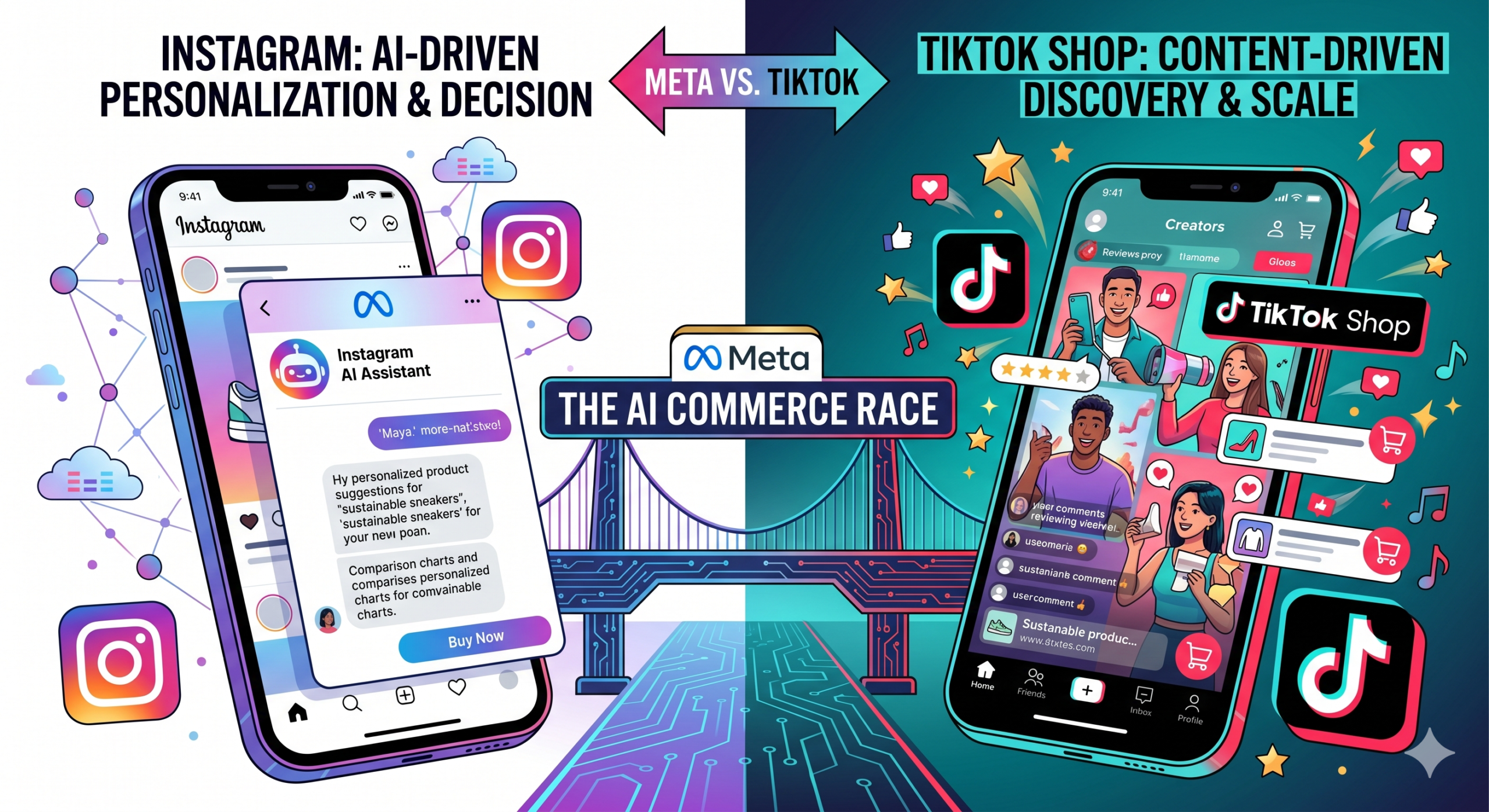
The battle for the future of eCommerce is entering a new phase—and this time, it’s powered by artificial intelligence.
Meta is reportedly preparing to launch AI shopping agents within Instagram, a move that directly targets TikTok Shop’s rapid rise. This is not just another feature update. It signals a deeper shift: the convergence of social media, AI, and commerce into a single experience.
From Social Platform to Shopping Engine
Instagram has long been a place for product discovery. Users scroll, find inspiration, and click through to external sites.
But with AI shopping agents, that flow could change completely.
Instead of:
👉 Discover → Leave app → Search → Buy
The new model becomes:
👉 Discover → Ask AI → Decide → Buy (all within the app)
This reduces friction and keeps the entire customer journey inside the platform.
What AI Shopping Agents Actually Do
AI agents go beyond recommendations. They act more like digital shopping assistants.
Within Instagram, they could:
- Answer product-related questions
- Compare different options
- Suggest personalized choices
- Complete purchases or guide decisions
This transforms shopping from a manual process into something assisted—or even automated.
A Direct Response to TikTok Shop
Meta’s move is clearly strategic.
TikTok has:
- Turned content into a sales engine
- Integrated shopping directly into the platform
- Proven that social commerce can scale
Now, Meta is responding by adding a new layer:
👉 AI-driven decision-making
While TikTok focuses on discovery through content, Meta is betting on intelligent assistance to improve conversion.
The Real Competition: Control of the Funnel
This is not just about features—it’s about who owns the entire shopping journey.
Traditionally:
- Social platforms handled discovery
- Marketplaces handled conversion
Now, both Meta and TikTok are trying to own:
👉 Discovery + Consideration + Purchase
Adding AI agents gives Meta an advantage in the decision phase, where many purchases are won or lost.
Implications for Brands
For brands, this shift changes how they compete.
Success will depend on:
- Being visible within AI-driven recommendations
- Providing clear, structured product data
- Building trust signals (reviews, credibility, content)
In this new model:
👉 It’s not just about being seen—it’s about being chosen by AI
A New Layer of Competition
This also introduces a new type of competition:
- TikTok → wins on content and attention
- Meta → aims to win on AI and personalization
Both approaches are powerful, and they may eventually converge.
At the same time, platforms like Amazon and Google are also integrating AI into search and shopping, making this a multi-front battle.
Challenges Ahead
Despite the potential, there are open questions:
- Will users trust AI to make purchase decisions?
- How transparent will recommendations be?
- How will brands influence AI-driven outcomes?
Execution will be critical.
The Bigger Picture
What we’re seeing is the emergence of a new model:
- Commerce embedded in social platforms
- AI embedded in decision-making
- Content driving both discovery and conversion
Shopping is becoming less about browsing—and more about delegating decisions to intelligent systems.
Final Thought
Meta’s move into AI shopping agents is not just about catching up with TikTok—it’s about redefining how people buy.
The future of eCommerce will not be decided by who has the best platform alone, but by who best combines:
- Attention (content)
- Intelligence (AI)
- Execution (commerce infrastructure)
In the end, the key question is no longer:
“Where do people shop?”
But:
“Who helps them decide what to buy?”

From the publisher
Everything we know about running Amazon, in one course.
The commercial strategy, taught by operators who run our own brands.
 Erene Araojo