

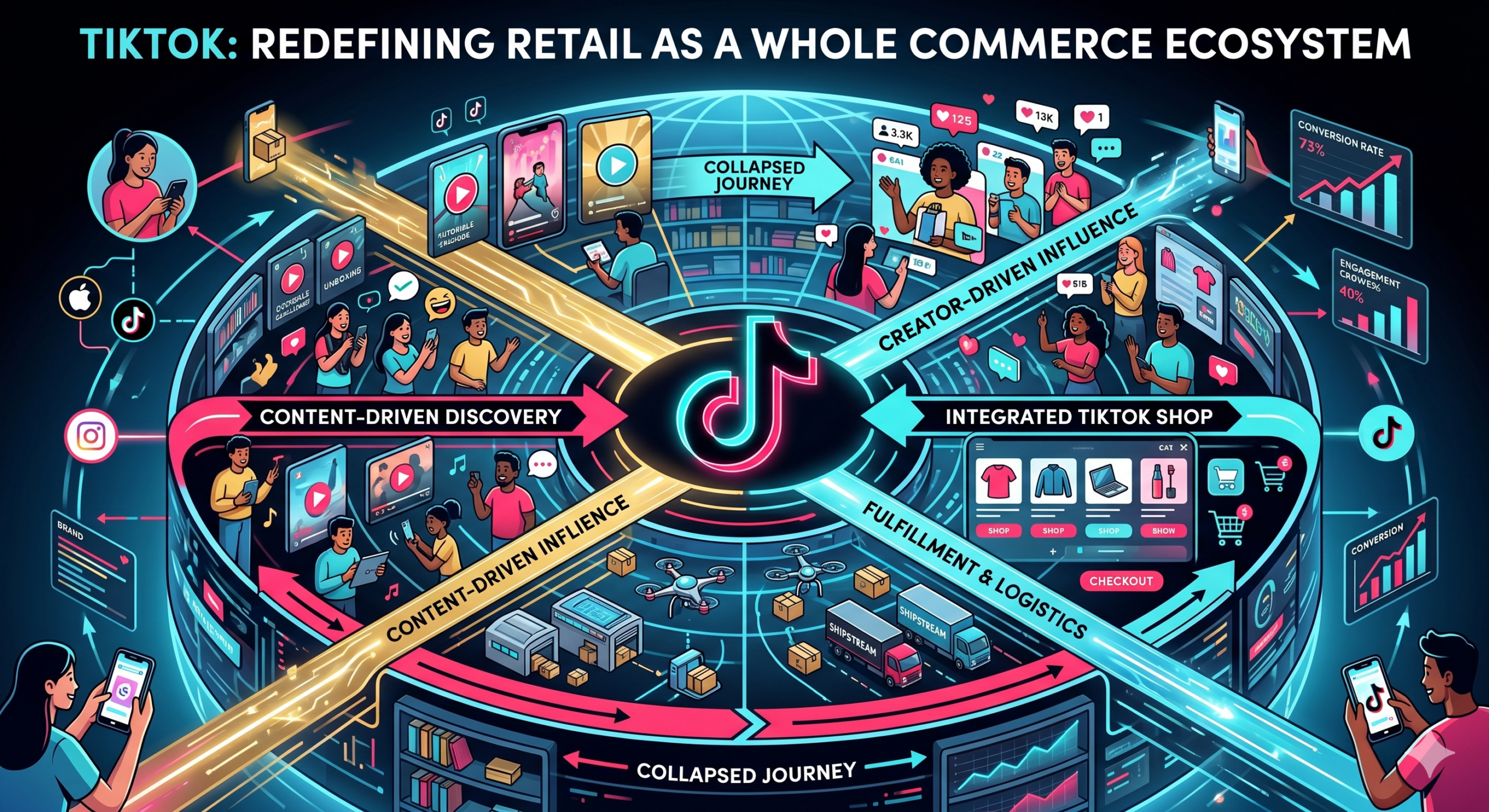
“Which ecosystem are we part oTikTok is no longer positioning itself as just a social platform—or even just a shopping channel. According to its European leadership, it is becoming something much bigger: a full commerce ecosystem.
This shift is not just about adding features. It reflects a deeper ambition to control every layer of the shopping experience—from discovery to purchase to fulfillment.
From Platform to Ecosystem
Most digital platforms specialize in one part of the value chain:
- Social media → attention and discovery
- Marketplaces → transactions
- Logistics players → fulfillment
TikTok is attempting to combine all three.
Its ecosystem now includes:
- Content-driven discovery
- Integrated shopping (TikTok Shop)
- Creator-driven sales
- Growing logistics and fulfillment capabilities
This creates a vertically integrated system where everything happens in one place.
Owning the Entire Funnel
Traditionally, the customer journey is fragmented:
👉 Discover on social → search on Google → buy on Amazon
TikTok is collapsing that journey into a single environment:
👉 Discover → engage → decide → buy
By doing this, it gains control over:
- User attention
- Purchase decisions
- Transaction data
This is what turns a platform into an ecosystem.
Why This Model Is Powerful
The strength of TikTok’s approach lies in integration.
When all parts of commerce are connected:
- Friction is reduced
- Conversion rates increase
- Data flows continuously across the system
For example:
- Content drives traffic to products
- Purchases generate data
- Data improves future content targeting
This creates a self-reinforcing growth loop.
A New Type of Competition
TikTok’s model changes how companies compete.
Instead of competing in isolated areas:
- Amazon dominates logistics and search
- Instagram dominates social discovery
- Shopify enables storefronts
TikTok is competing across all of them at once.
This makes it harder to categorize—and harder to compete with using traditional strategies.
The Role of Creators
Creators are a key part of this ecosystem.
They:
- Drive discovery
- Build trust
- Generate demand
Unlike traditional retail, where brands control messaging, TikTok’s ecosystem is creator-led.
This adds speed and authenticity—but also complexity.
Challenges to Scaling
Becoming a full ecosystem comes with challenges:
- Maintaining trust and product quality
- Scaling logistics globally
- Managing regulatory and compliance issues
- Balancing creator freedom with brand control
Execution at scale will determine whether TikTok can sustain its growth.
The Bigger Picture
TikTok’s evolution reflects a broader trend:
👉 Platforms are no longer just channels—they are becoming end-to-end commerce systems
This has major implications:
- Brands may rely less on external marketplaces
- Customer journeys become more centralized
- Data becomes more powerful and actionable
Final Thought
When TikTok says it is “a whole commerce ecosystem,” it is not just a positioning statement—it is a roadmap.
The future of retail may not belong to companies that dominate one part of the value chain, but to those that connect every part seamlessly.
In that world, the key question is no longer:
“Where do we sell?”

From the publisher
Everything we know about running Amazon, in one course.
The commercial strategy, taught by operators who run our own brands.
 Erene Araojo