

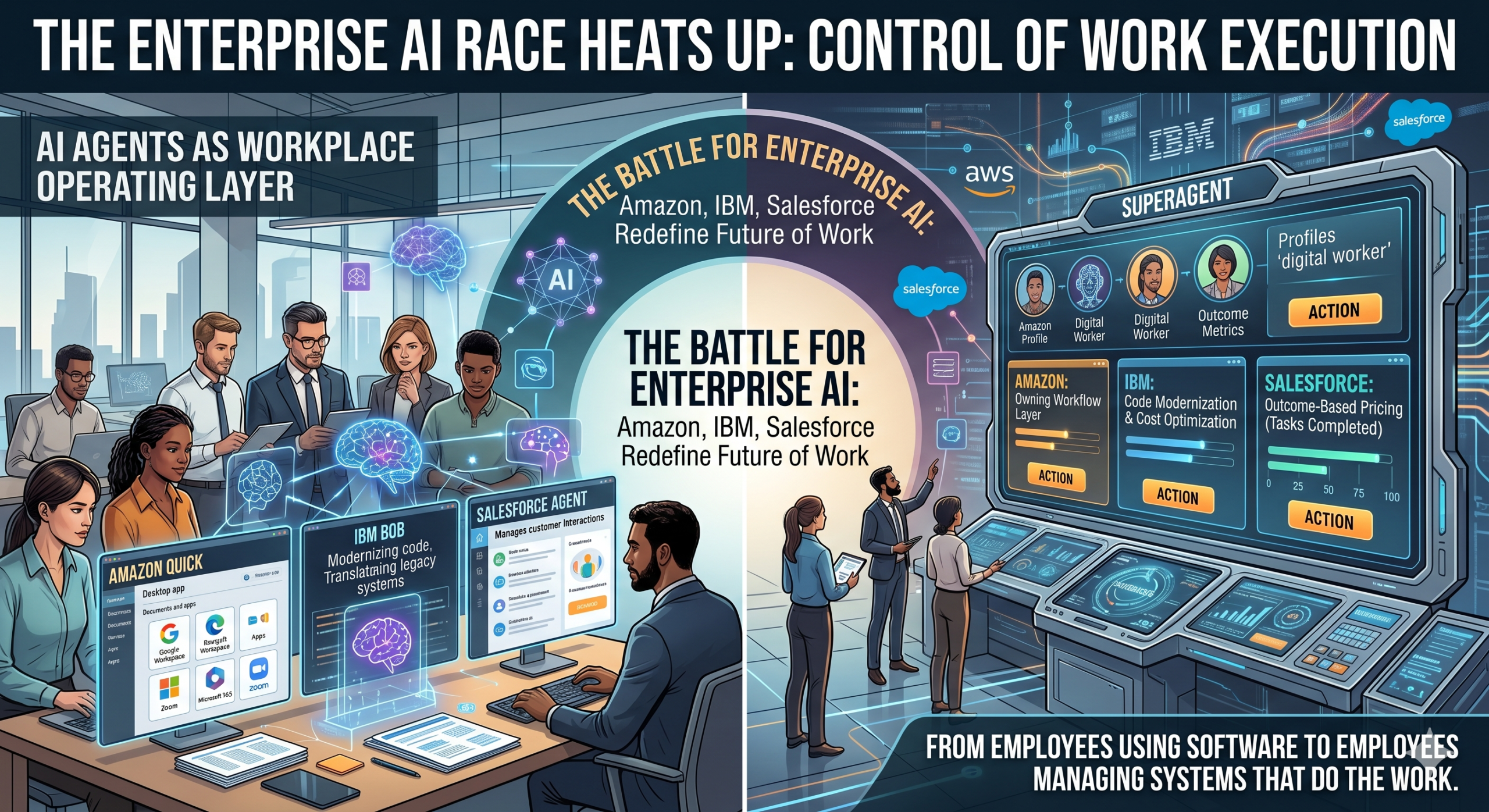
This week made one thing clear: the battle for enterprise AI is no longer just about models—it’s about who controls how work gets done.
From Amazon opening access to OpenAI models on AWS, to launching its own AI agent app, to IBM and Salesforce reshaping how software is built and priced, the industry is moving toward a new paradigm: AI as the operating layer of the workplace.
Amazon’s Big Move: From Cloud to Co-Worker
Amazon Web Services (AWS) has long dominated cloud infrastructure. Now, it’s trying to move up the stack.
Two key developments highlight this shift:
- AWS can now offer OpenAI models to its customers
- It launched Amazon Quick, a desktop app powered by AI agents
Quick is designed to act as a digital co-worker, capable of handling tasks like:
- Creating presentations and documents
- Working across apps like Google Workspace, Microsoft 365, Zoom, and Salesforce
- Managing files and workflows in the background
Notably, it doesn’t even require an AWS account and starts at $20/month—suggesting Amazon is aiming for broad adoption beyond its core cloud base.
The Rise of “Superagents”
Amazon is entering a crowded but critical space: AI agents that can operate across tools like humans do.
The idea is simple but powerful:
Instead of employees switching between apps, AI agents will:
- Navigate tools autonomously
- Execute multi-step workflows
- Connect systems via APIs or direct interface control
This is often referred to as the rise of “superagents”—digital workers that don’t just assist, but act.
Amazon Quick is its answer to tools like:
- Anthropic’s Claude-based assistants
- Microsoft Copilot ecosystem
- Emerging autonomous agents across startups
The goal is clear: own the workflow layer, not just the infrastructure.
AWS’s Ongoing Challenge
Despite its dominance in cloud, AWS has historically struggled to build must-have enterprise applications—the kind that drive daily usage and lock in customers.
Competitors like Microsoft and Google have an advantage:
- They bundle cloud + productivity tools (Office, Workspace)
- They embed AI directly into those ecosystems
Quick is Amazon’s attempt to close that gap. But early signals are mixed.
Even its previous product, Amazon Q, failed to gain strong traction despite similar ambitions.
The big question remains:
👉 Can AWS become more than just the backend of AI—and move into the front-end of work?
IBM’s Parallel Fight: Relevance in AI Coding
Amazon isn’t alone in this struggle.
IBM is also trying to regain relevance in the AI era, particularly in software development tools.
Its new product, Bob, focuses on:
- Translating legacy systems into modern code
- Helping enterprises update applications and databases
- Optimizing which AI models to use based on cost and performance
Unlike broader coding agents, Bob targets a specific enterprise pain point: modernization.
Its key differentiator is efficiency:
👉 choosing between high-end models (like Claude) and cheaper alternatives dynamically
This reflects a growing reality in AI:
performance matters—but cost optimization matters just as much.
A New Business Model: Paying for Outcomes
While companies race to build better AI tools, they are also rethinking how to charge for them.
Salesforce is leading this shift with a move toward outcome-based pricing.
Instead of charging for:
- Seats (users)
- Or usage (tokens, API calls)
Companies may soon charge based on:
👉 tasks completed by AI
For example:
- Scheduling appointments
- Resolving customer queries
- Completing workflows
This model aligns pricing with value:
👉 You pay when the AI actually does something useful
It also signals a deeper shift:
software is no longer a tool—it’s becoming labor.
The Bigger Picture: Who Owns the Future of Work?
Across all these moves, a clear pattern is emerging:
- Amazon → building AI co-workers
- IBM → optimizing enterprise workflows
- Salesforce → redefining pricing around outcomes
The common thread is not AI itself—but control over work execution.
The next generation of enterprise software will not just:
- Store data
- Or enable tasks
It will:
👉 perform the work directly
Final Thought
We are moving from a world where employees use software…
to one where they manage systems that do the work for them.
The winners in this new landscape will not just build better AI models—but platforms that:
- Integrate deeply into workflows
- Deliver measurable outcomes
- And redefine how productivity is measured
In the end, the real competition is not for users or even customers—
it’s for control of the digital workforce.

From the publisher
Everything we know about running Amazon, in one course.
The commercial strategy, taught by operators who run our own brands.
 Erene Araojo