

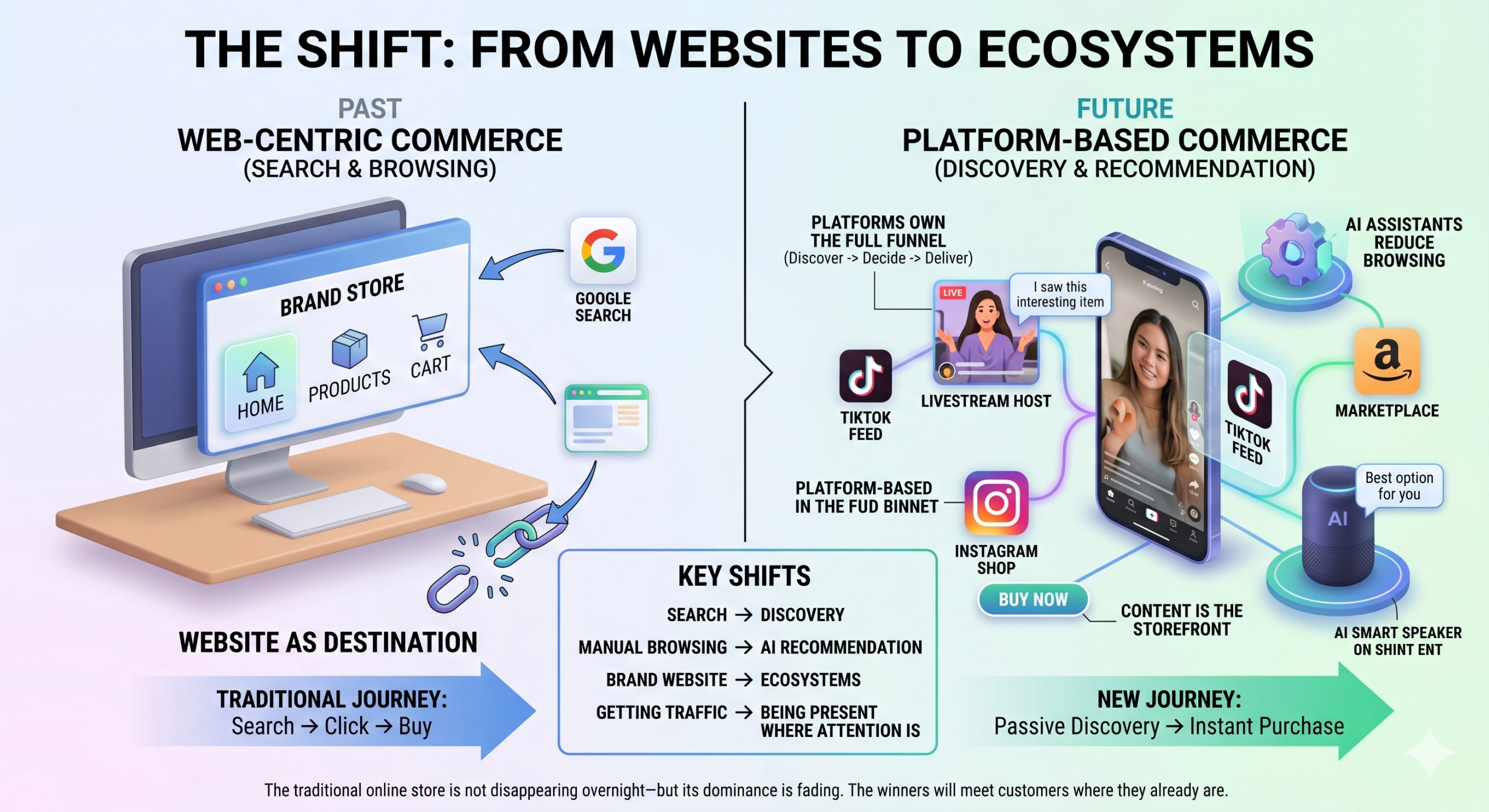
For years, the website was the center of eCommerce.
Brands invested heavily in:
- Driving traffic to their online stores
- Optimizing landing pages
- Improving checkout experiences
- Ranking higher on Google
The goal was simple:
👉 get customers onto your website.
But that model is starting to change.
Today, shopping is increasingly happening outside traditional online stores—inside platforms like TikTok, Instagram, Amazon, and even AI-powered assistants.
The future of commerce may not belong to websites at all.
Discovery Is Replacing Search
Traditional eCommerce was built around search.
Customers:
- Knew what they wanted
- Went to Google or Amazon
- Searched using keywords
- Compared products manually
Now, consumers increasingly discover products passively through:
- TikTok videos
- Instagram content
- Livestreams
- Creator recommendations
Instead of:
👉 “I need to buy something”
The process becomes:
👉 “I saw something interesting—and bought it.”
This shift changes the entire customer journey.
Platforms Now Own the Full Funnel
Social platforms are no longer just marketing channels.
TikTok Shop, Instagram, and Amazon are building ecosystems where users can:
- Discover products
- Get recommendations
- Complete purchases
- Track deliveries
all without leaving the platform.
This means platforms increasingly control:
- Attention
- Discovery
- Conversion
- Customer data
The website is no longer the destination—it’s becoming optional infrastructure.
AI Is Accelerating the Shift
Artificial intelligence is making this transformation even faster.
AI shopping agents and conversational search tools are reducing the need for traditional browsing.
Instead of opening multiple tabs and comparing products manually, consumers can simply ask:
“What’s the best option for me?”
AI systems will:
- Compare products
- Analyze reviews
- Recommend choices
- Potentially complete purchases automatically
In this world, customers may interact more with AI than with brand websites themselves.
Content Becomes the Storefront
As platforms take over commerce, content becomes more important than websites.
Short-form videos, creator content, comments, and livestreams now drive:
- Product discovery
- Trust
- Conversion
Brands are shifting from:
👉 website-first strategies
to:
👉 content-first commerce strategies
The storefront is no longer a homepage.
It’s a feed.
What This Means for Brands
Brands now face a major strategic shift.
Success will increasingly depend on:
- Platform-native content
- Creator partnerships
- AI visibility and recommendation systems
- Fast, frictionless purchasing experiences
Driving traffic to a standalone website may become less important than:
👉 being present where attention already exists.
Will Websites Disappear?
Probably not.
Websites will still matter for:
- Brand identity
- Customer service
- Owned data and loyalty
- Backend operations
But their role is changing.
Instead of being the center of commerce, websites may become:
👉 infrastructure behind the scenes.
The front-end experience is moving elsewhere.
The Bigger Picture
What’s happening is bigger than social commerce or AI.
We are witnessing a shift:
- From search → to discovery
- From websites → to ecosystems
- From browsing → to recommendation
- From ownership → to platform dependency
Commerce is becoming embedded into everyday digital experiences.
Final Thought
The traditional online store is not disappearing overnight—but its dominance is fading.
In the next phase of eCommerce, the winners may not be the brands with the best websites, but the ones that:
- Understand platforms
- Master content
- Adapt to AI-driven discovery
- And meet customers where they already spend their time
Because the future of shopping may not happen on websites at all.
It may happen everywhere else.

From the publisher
Everything we know about running Amazon, in one course.
The commercial strategy, taught by operators who run our own brands.
 Erene Araojo