

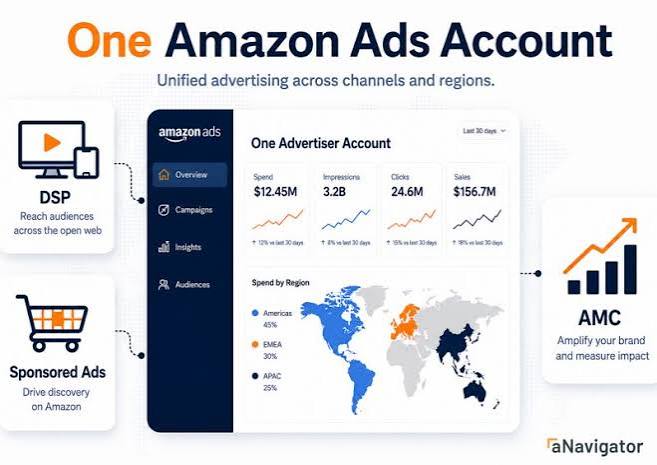
If you advertise on Amazon in more than one European country, the account you log into this week is not the account you had in July. On 30 July 2026 Amazon Ads began converting existing Amazon DSP advertiser accounts into a single advertiser account that reaches 34 countries, seventeen of them European. Programmatic buying, Sponsored Ads and Amazon Marketing Cloud now sit behind one login, one billing page and one set of user roles. No advertiser action was required, and no existing integration broke.
The operational win is real, and for European sellers it is the largest single administrative saving Amazon Ads has shipped in two years. But it is worth being clear about what a consolidation consolidates. One global seat is also one global view of your data, held by the company that owns the inventory, sets the fee and increasingly makes the buying decision. The change that removes your logins also removes the structural reason to have someone else hold the account on your behalf.
What actually changed
Amazon groups the upgrade into five capabilities, and each closes a gap European operators have worked around for years.
- Multi-country buying. Programmatic campaigns activate across the Americas, EMEA and APAC without new accounts or further registrations. Region and country are selected inside a single account at campaign creation.
- Omnichannel campaign management. The account switch between programmatic buying and Sponsored Ads is gone. Both sit in the same advertiser account.
- Amazon Marketing Cloud access. The upgrade itself provisions clean room access. Separate registration is no longer part of the sequence.
- Unified billing and permissions. Invoices, billing settings and the admin, editor and viewer roles consolidate onto one page spanning all ad products globally.
- Simplified first-party data management. Signals connect once, through Ads Data Manager, then activate across Amazon DSP, Amazon Marketing Cloud and Sponsored Ads.
Amazon’s framing of the problem is unusually blunt for a launch note: advertising across its product suite and multiple countries has historically required separate accounts, distinct registrations, fragmented billing and permission workflows, and redundant data uploads. The new structure, the announcement says, “eliminates this complexity.”

From the publisher
Everything we know about running Amazon, in one course.
The commercial strategy, taught by operators who run our own brands.
The European read-through: seventeen markets, one invoice
Europe is the largest bloc in the footprint, and the list is worth reading in full because it decides whether this story is yours: Germany, Spain, France, Italy, the United Kingdom, Belgium, Switzerland, Poland, Turkey, Austria, the Netherlands, Sweden, Finland, Norway, Ireland, Denmark and Luxembourg. Seventeen markets. North America adds the United States, Canada and Mexico, South America adds Brazil alone, the Middle East adds seven and Asia Pacific six. Thirty-four countries in total.
Concretely: a brand advertising in eight European markets previously needed eight account contexts, per-entity billing, per-account permissions and per-market audience uploads. That collapses into one account, one billing page, one permission model and one data connection. If you have ever hunted through five national logins for an audience you built last quarter, that is the tax being refunded.
The perimeter is also deliberately familiar. It matches, market for market, the footprint Amazon used when it expanded in-market audiences to 32 countries with unified targeting definitions in November 2025. One geographic map now spans audiences, reporting and account identity.
One account across seventeen European markets only helps if your listings are ready to receive the traffic. Helium 10 handles the keyword research and listing localisation per marketplace, so the ad spend you can now route anywhere lands on a page built for that country. Code ECOMMGM10.
Affiliate link. E-CommSphere may earn a commission at no extra cost to you.
Why nothing broke on Monday
The most consequential detail for anyone running scripts or a connected reporting stack sits in the API section rather than the marketing copy. Accounts receive a new advertiser account ID that replaces the legacy Amazon DSP advertiser account ID, plus a new Global Account ID and additional regional identifiers. At the same time, existing advertiser account identifiers, the CFIDs, continue to work without modification.
Both statements sit in the same document, which tells you the migration is additive rather than breaking: old identifiers still resolve, new ones arrive alongside them. Mappings between the two come back from a POST call to the advertiser accounts query endpoint. For cross-border campaign creation, a country code passes as an optional parameter in the campaigns endpoint, and when no code is supplied campaigns default to the original country. That default is the quiet piece of good engineering here: nobody running scripted campaign creation at volume will see budget drift silently into a new market. The account change is not opt-in. The new capability is.
The clean room stops being a separate ask
For most sellers the largest change here is Amazon Marketing Cloud. Access is provisioned by the upgrade, inside the advertiser account, and first-party campaign and events data across all products globally can be analysed in one instance rather than one per market. Cross-product attribution, the question that has dogged retail media buyers for years, becomes answerable in a single place.
This continues a pattern rather than starting one. Amazon opened the clean room directly to sponsored ads advertisers in September 2025, collapsed Amazon DSP and Sponsored Ads into one Campaign Manager interface at unBoxed in November 2025, and moved consolidated reporting to general availability on 8 June 2026, with two legacy Ads Console tools due for retirement by 31 December 2026.
On the data side, control sits at dataset level: advertisers determine which datasets are shared with which accounts and for which use cases, whether audience targeting, conversion attribution or analytics. Connecting once need not mean sharing everything with everything, but those defaults are now yours to inspect rather than enforced by separate accounts.
What the consolidation is for
Amazon has not stated a plan to displace the agency layer, and it would be wrong to claim it has. But read the announcement again and notice what is missing. There is nothing about the layer above the advertiser: multi-account management across client portfolios, the daily terrain of every media agency, goes entirely unaddressed. In a document about who holds the account, the party that traditionally held it on the advertiser’s behalf does not appear.
Put that next to price. AdExchanger reported in November 2025 that Amazon DSP charges no fee on programmatic guaranteed deals over Amazon-owned media and 1% for ads on open web publishers. Digiday’s October 2025 reporting, drawing on ad buyers surveyed through the year, placed typical Amazon DSP fees between 4% and 8%. Vlad Chubakov, Associate Director of Programmatic at Delve Deeper, made the structural point plainly: “Amazon can slash margins because they own the pipes.”
Then put it next to automation. On 22 July 2026 Amazon Ads published ten new capabilities for Brand+ and Performance+, its automated campaign products inside Amazon DSP. Four of the ten switch on by default. The most consequential swaps a buyer decision for a platform one: Automatic Deal Selection for Brand+ streaming television entered open beta enabled by default on new prospecting lines, with the system assembling and refreshing the deal set. Nicole Goksel, senior product manager for the capability at Amazon Ads, described what it replaced: “Previously, Brand+ campaigns ran on a single, pre-configured deal.” Opting out remains possible. The starting position has flipped.
Kelly MacLean, the Amazon Ads vice president overseeing the DSP, told Digiday in January 2025 that the company wants the product to become “the largest AI-driven buying platform for all digital marketers.” Cheaper pipes, software where the traders used to sit, and now a single seat needing no intermediary to reconcile it. Each piece is defensible alone. Together they describe a buying path with one fewer human in it.
When the platform assembles the buy and then grades its own performance, you need a number that does not come from the platform. Helium 10 gives you independent keyword rank, share of voice and profit tracking to check Amazon’s reporting against. Code ECOMMGM10.
Affiliate link. E-CommSphere may earn a commission at no extra cost to you.
What the announcement does not say
Four gaps are worth holding on to, because they decide whether this applies to you at all:
- It covers Amazon DSP-only advertisers. The automatic upgrade is available to that group. If your only Amazon advertising is Sponsored Ads, this wave is not about you.
- There is no completion date. The wave was announced without a published end date, so an account that has not changed yet is not an account that was skipped.
- Managed-service accounts are unaddressed. Whether they follow the same path as self-service accounts has not been stated.
- Minimum spend is unaddressed. Amazon DSP has historically carried spend commitments and Sponsored Ads has not. What happens when both live in one account has not been made public.
The operator checklist
Nothing here requires action, which is exactly why it deserves ten minutes rather than none. Open the account selector and confirm your account now sits under the advertiser account category rather than inside the Advertisers page of Campaign Manager, because the navigation path your team has used for years has moved. Then check the three things consolidation rewrote quietly: who holds admin, editor and viewer roles now that those roles span every product in every market, which billing settings survived the merge onto one page, and which datasets are shared with which accounts. Permissions that were safely fragmented across five national accounts are global by default now. That is the point of the upgrade, and it is also the risk in it.
Sources
- PPC Land, Amazon DSP advertisers gain a single global account across 34 countries
- PPC Land, Amazon DSP gets one global login. Is the agency the next thing it removes?
- Amazon Ads, Manage all ad products globally with the advertiser account, 30 July 2026
 Jorge Callejo