

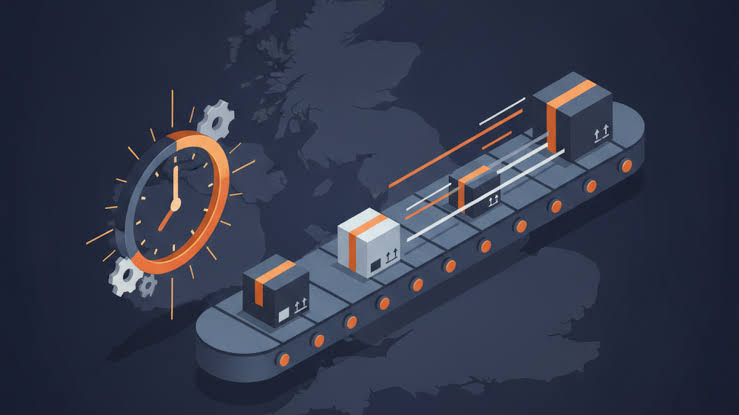
Amazon has set a hard deadline that puts a new number at the centre of every seller-fulfilled operation aimed at business buyers. From September 30, every professional seller must keep a Business Hour Delivery Rate of at least 90% on seller-fulfilled (FBM) orders placed through Amazon Business in the United States, the United Kingdom and Germany. Sellers still below that line by October 30 will have their offers deactivated for Business buyers. The single fulfilment method exempted from the rule is Amazon’s own: Fulfilled by Amazon (FBA).
We are treating this as the most consequential Amazon change of the week, and the reason is structural rather than dramatic. The metric measures something the seller does not directly control, and the escape hatch leads straight back to Amazon’s warehouses. For European operators running FBM into the UK and Germany, this is not a distant US pilot. Both markets are named from day one, with the same date and the same threshold.
Watch: the breakdown on The E-Commerce Weekly, Ep. 3
We walk through the key takeaways in this week’s episode. Full written analysis continues below.

From the publisher
Everything we know about running Amazon, in one course.
The commercial strategy, taught by operators who run our own brands.
What the Business Hour Delivery Rate actually measures
The Business Hour Delivery Rate is not a shipping-speed metric in the way sellers are used to thinking about performance. It measures whether the parcel physically arrives during the buying business’s opening hours. A package that turns up at a closed loading dock at 7pm, or on a Saturday when the office is dark, counts against the seller even if it was dispatched on time and travelled fast.
That distinction matters because it moves the goalposts from a moment the seller controls (handing the parcel to the carrier) to a moment the seller does not (when the carrier’s van reaches the door). A seller can pick, pack and ship flawlessly and still miss the mark because a courier ran its route in the wrong order, or delivered at the end of the day instead of the start of it. The rule holds the seller accountable for the last leg of a journey that a third-party carrier owns.
Amazon’s logic is coherent from the buyer’s side. A business buyer ordering supplies wants them to arrive while someone is there to receive them, not left at a shuttered premises overnight. The friction is that Amazon has attached a deactivation penalty to an outcome that sits largely outside the merchant’s hands, and it has done so with a fixed threshold of 90% and two fixed dates.
The dates, and why they are not a soft rollout
There are two dates to plan around. September 30 is when the 90% requirement takes effect. October 30 is the enforcement line: sellers still under 90% on that date get their offers deactivated for Business buyers. That gives roughly a month between the standard going live and the penalty landing, which is a narrow window to diagnose a carrier problem, change providers or routes, and see the metric recover.
The geography is the part European sellers should read twice. The United Kingdom and Germany are included from the start, alongside the United States. This is not a US-only trial that reaches Europe later. An FBM seller shipping business orders into Germany or the UK is inside the scope of this rule on the same September 30 date as a seller in the US, and faces the same October 30 deactivation risk.
Tool comparison · FastMoss vs Kalodata
When a marketplace ties your account health to a metric you only partly control, the response is data, not guesswork. Analytics platforms that surface delivery timing, regional demand and channel performance let you see where a problem is forming before it costs you a listing. We are lining up a side-by-side of FastMoss and Kalodata so operators can judge which reporting depth fits their workflow.
Comparison coming soon
FTC disclosure: this section may contain affiliate links. If you sign up through them we may earn a commission at no extra cost to you. We only feature tools we consider genuinely useful to sellers.
The exemption points back to FBA
The rule carves out one exception, and it is the one worth sitting with. FBA is exempt. Orders fulfilled from Amazon’s warehouses are not measured against the Business Hour Delivery Rate at all. The only fulfilment path guaranteed to clear the new bar is the one Amazon runs itself.
Read plainly, the incentive structure is this. A seller who wants to keep serving Amazon Business buyers without carrying deactivation risk on a metric they cannot fully govern has a clean route available: move that inventory into FBA. The seller who stays on FBM keeps control of margin and stock but inherits a delivery-timing standard enforced by a carrier’s schedule.
We are not reading intent here, only the shape of the choice. The effect, whatever the intent, is that the new requirement makes FBA the safe harbour for business orders and leaves seller-fulfilled merchants to solve a last-mile timing problem on their own. For a European operator who chose FBM deliberately, to protect margin, to hold stock outside Amazon’s network, or to serve slower-moving lines, that is a real strategic cost, not just an operational nuisance.
Why Amazon is pushing so hard on business buyers
The pressure makes more sense against the size of the prize. Amazon Business generated $35 billion in annualized gross sales by 2025. That is the segment these delivery standards are meant to protect. Amazon is tightening the service level on the exact orders that feed a $35 billion business, and it is willing to attach deactivation to that tightening.
The same week brought a second signal in the same direction. Amazon opened FBM pallet delivery to third-party sellers, extending a bulk-fulfilment option that had been available on the FBA side. During its pilot, Amazon found that 80% of business customers chose pallet delivery when it was offered. And on the FBA side, the company reported that in its 2025 research, US FBA pallet orders generated an average of 16 times more revenue per order than non-pallet orders.
Those two numbers frame the strategy. Business buyers overwhelmingly want pallet delivery when they can get it, and pallet orders through FBA are dramatically larger by revenue per order than standard ones. Amazon is building out the plumbing to capture bigger, higher-value B2B orders, and the Business Hour Delivery Rate is the quality gate that sits alongside it. The pallet option now reaching FBM sellers is the carrot; the 90% delivery-rate rule is the stick.
Tool comparison · FastMoss vs Kalodata
A $35 billion B2B channel with a 16x revenue gap between pallet and non-pallet orders is worth understanding before you decide where to put your stock. Category and demand analytics help you spot which of your lines actually attract business buyers, so an FBA-versus-FBM call is grounded in numbers rather than instinct. Our FastMoss versus Kalodata breakdown will map what each tool shows.
Comparison coming soon
FTC disclosure: this section may contain affiliate links. If you sign up through them we may earn a commission at no extra cost to you. We only feature tools we consider genuinely useful to sellers.
What European FBM operators should weigh now
The decision in front of a seller-fulfilled merchant is not abstract. It is whether the Amazon Business channel is worth the delivery-timing risk on FBM, and if it is, whether the answer is to fix the last mile or to move the affected inventory into the exempt path.
The last-mile route means treating carrier delivery timing as an account-health input, not a background logistics detail. That means knowing, per carrier and per region, whether parcels are actually landing inside business hours in the UK and Germany, and it means having enough visibility to act inside the roughly one-month window between September 30 and October 30 if a carrier is dragging the rate below 90%. A merchant who only discovers the problem when the deactivation notice arrives has already lost the window.
The FBA route removes the metric entirely for the affected orders, at the usual cost: fees, loss of direct stock control, and dependence on Amazon’s network. For high-value business lines, especially anything that fits the pallet pattern Amazon is now promoting, the exemption plus the pallet economics may make FBA the rational home for that slice of the catalogue, even for a seller who runs FBM everywhere else.
What no European operator should do is treat this as a US story that will reach them later. The rule names the UK and Germany on the same date as the US, with the same 90% threshold and the same October 30 deactivation trigger. The clock is the same clock everywhere it applies.
The broader read is that Amazon is raising the service bar on its fastest-growing high-value segment and, in the same motion, steering seller-fulfilled merchants toward its own fulfilment network for the orders that matter most to that segment. The 90% Business Hour Delivery Rate is where that pressure becomes a date on the calendar. September 30 sets the standard. October 30 enforces it. Every FBM seller with Amazon Business orders in the US, UK or Germany now has a decision to make before then.
Sources
- EcommerceBytes, “Amazon Holds B2B Conference as It Leans on Sellers to Appeal to Business Buyers,” July 19, 2026. https://www.ecommercebytes.com/2026/07/19/amazon-holds-b2b-conference-as-it-leans-on-sellers-to-appeal-to-business-buyers/
 Erene Araojo